

Office of the Privacy Commissioner of Canada’s 2026-27 Departmental Plan
(The original version was signed by)
The Honourable Sean Fraser, P.C., K.C., M.P.
Minister of Justice and Attorney General of Canada
On this page
From the Privacy Commissioner of Canada
Plans to deliver on core responsibilities and internal services
Core responsibility 1: Protection and Promotion of Privacy Rights
Department-wide considerations
Planned spending and human resources
Future-oriented condensed statement of operations
Supplementary information tables
Copyright information
© His Majesty the King in Right of Canada, as represented by
the Minister of Justice and Attorney General of Canada, 2026
Catalogue No. IP51-6E-PDF
ISSN 2371-7955
At a glance
This departmental plan details the Office of the Privacy Commissioner of Canada’s (OPC) priorities, plans, and associated costs for the upcoming three fiscal years.
It aligns with the priorities outlined in the OPC’s Vision, mission, raison d’être and operating context.
Key priorities
The OPC identified the following key priorities for 2026-27:
- Protecting and promoting privacy with maximum impact by optimizing resources and making sure that the OPC maintains an agile structure and processes that are responsive to Canadians’ needs, by using business intelligence to identify trends that need attention, producing focused guidance and outreach, leveraging strategic partnerships, and preparing for the implementation of potential new privacy legislation;
- Addressing and advocating for privacy in this time of technological change with a focus on artificial intelligence (AI) and generative AI, the proliferation of which brings both potential benefits, and increased risks to privacy;
- Championing children’s privacy rights to ensure that their unique privacy needs are met, and that they can exercise their rights.
Comprehensive Expenditure Review
The government is committed to restraining the growth of day-to-day operational spending to make investments that will grow the economy and benefit Canadians.
The OPC proactively reduced the number of executive positions by 10% as part of a major reorganization in 2025.
The OPC will, however, respect the spirit of the exercise by doing the following in the coming year:
- continue to build on its ongoing transformation and review of internal structures and resources, and to streamline processes and enhance efficiency. The transformation aims to optimize operations, amplify results, and deliver services to Canadians with the highest possible effectiveness.
- continue advancing its AI strategy to strengthen its own analytical and operational capacity, while contributing to the broader dialogue on the ethical, transparent, and responsible use of AI in regulatory environments.
This departmental plan reflects these measures.
Highlights for OPC in 2026-27
Protecting and promoting privacy with maximum impact:
- Continue to improve the efficiency and effectiveness of OPC activities to address the increase in the volume of complaints, meet its mandate, and prepare for the implementation of potential new privacy legislation.
- Foster domestic and international partnerships with regulatory authorities to share knowledge and expertise, ensure coordinated responses and harmonized approaches to privacy issues and seek opportunities to maximize external partnerships and networks.
- Continue to enhance internal awareness, knowledge and expertise in terms of advanced and emerging technologies in order to effectively address the privacy challenges posed by these new technologies.
- Enhance the OPC’s knowledge and expertise regarding children’s privacy, and share findings across the organization and with partners.
In 2026-27, total planned spending (including internal services) for the OPC is $37,560,292 and total planned full-time equivalent staff (including internal services) is 231.
Summary of planned results
The following provides a summary of the results the department plans to achieve in 2026-27 under its main areas of activity, called “core responsibilities.”
Core responsibility 1: Protection and Promotion of Privacy Rights
In 2026-27, the OPC will continue to protect and promote privacy in Canada by advancing its three strategic priorities and working to achieve the targets set out under its departmental results. This includes strengthening compliance with federal privacy laws, striving for timely resolution of privacy complaints and breaches reported to the OPC, and undertaking proactive enforcement activities that address areas of highest impact for Canadians.
The OPC will foster greater public awareness and trust in the digital environment and deepen its understanding of emerging issues through research, information, guidance, and engagement activities. The OPC will also provide timely advice to parliamentarians and contribute to the adoption of laws that improve privacy protection for Canadians.
Planned spending: $27,588,232
Planned human resources: 172
More information about the Protection and Promotion of Privacy Rights can be found in the full plan.
For complete information on the OPC’s total planned spending and human resources, read the Planned spending and human resources section of the full plan.
From the Privacy Commissioner of Canada

I am pleased to present the 2026-27 Departmental Plan for the Office of the Privacy Commissioner of Canada (OPC).
The OPC operates in a rapidly changing environment, one in which Canadian’s personal information is being collected and used in tremendous volumes. New and evolving technologies and the increasing use of personal data bring opportunities to connect, to create, and to innovate. At the same time, technological advances in areas such as data analytics, artificial intelligence (AI), robotics, biometrics and the Internet of Things pose new and complex privacy risks.
At this time of rapid, unprecedented change, prioritizing privacy must be our collective imperative. Trust in how data is handled is an increasingly important factor in how individuals interact with government, businesses, and technology, which is a significant consideration, particularly during challenging economic times.
In 2026-27, I will continue to focus my efforts on advancing my strategic priorities: maximizing the OPC’s impact, addressing the privacy implications of technologies like AI, and championing children’s privacy.
Privacy is a global issue that cannot be dealt with by any one country alone. Collaboration and cooperation among regulators, public institutions, industry, and civil society are essential to addressing global privacy challenges, including those related to children and technology.
Sharing knowledge and expertise, jointly examining emerging issues, and working together to advance common standards can provide greater consistency among organizations operating across jurisdictions and better privacy protections for individuals. To that end, I was honoured to be elected Chair of the Global Privacy Assembly in September 2025. This international forum is made up of more than 130 data protection and privacy authorities from all over the world.
This position comes at a key moment for the OPC and for Canada. Having the Privacy Commissioner of Canada in this global leadership role is an important opportunity to help shape the future of data protection globally, to support stronger privacy protections for individuals, and to ensure Canada’s economic success and digital sovereignty, by supporting digital trade and advancing Canada’s international presence.
In Canada, I regularly collaborate with my provincial and territorial counterparts. In the coming year, I will co-chair the federal, provincial, and territorial information and privacy commissioners and ombuds group alongside Caroline Maynard, the Information Commissioner of Canada.
As the digital economy continues to grow, I will continue to champion privacy and data protection in support of responsible innovation – setting the standard for a safer and more secure digital world for individuals, while supporting innovation, economic competitiveness and Canada’s digital sovereignty.
However, there are, number of factors that affect the OPC’s ability to effectively deliver on its mandate and strategic priorities. These include a rapidly evolving privacy landscape, a significant increase in the complexity and volume of our work, fiscal constraints, and reliance on the courts to implement OPC findings.
Temporary funding that allowed my Office to reduce investigative backlogs has ended. With complaint volumes continuing to rise, the OPC is entering a challenging period in which it must manage increasing demands with fewer resources.
In light of the current fiscal reality, both within the OPC and across the federal government, and in response to the growing workload, I launched a transformation plan last year that included reducing the number of executive positions and streamlining operations to improve efficiency and effectiveness. The plan includes implementing alternative approaches to full resource-intensive investigations like promoting compliance strategically and using the different tools at our disposal. We must exercise more stringent financial management, and find creative ways to leverage our organization’s strengths to position us for success.
Once fully implemented, the transformation will allow the OPC to respond faster and more efficiently to emerging issues, to broaden our approach to compliance, and to better align our policy and legal work, as well as our enforcement and advisory activities.
Consistent with this vision for privacy protection and our continued focus on delivering timely and impactful services to Canadians, we undertook a comprehensive review of our Departmental Results Framework and proposed new performance indicators starting in 2026-27. These new indicators will allow us to report more clearly on our performance going forward.
Last fall, I welcomed the comments from the Minister of Artificial Intelligence and Digital Innovation and Minister responsible for the Federal Economic Development Agency for Southern Ontario on the government’s plans to introduce modernized public- and private-sector privacy laws that recognize the realities of today’s digital economy. I look forward to proposals to modernize both acts and to once again having access to funding that was previously earmarked to prepare for the new responsibilities that would result from the reform.
Through modern, predictable laws that share common standards with like-minded countries, we can create a regulatory environment that makes it easier for Canadian businesses to engage and succeed in a globalized world.
This will benefit Canada’s economy and trade relationships, Canadian businesses, and Canadians by ensuring pragmatic and effective protections no matter where individuals or their data may travel.
(The original version was signed by)
Philippe Dufresne
Privacy Commissioner of Canada
Plans to deliver on core responsibilities and internal services
Core responsibilities and internal services
Core responsibility 1: Protection and Promotion of Privacy Rights
Description
Ensure the protection and promotion of privacy rights of Canadians; enforce privacy obligations by federal government institutions and private-sector organizations; provide advice to Parliament on potential privacy implications of proposed legislation and government programs; promote awareness and understanding of rights and obligations under federal privacy legislation.
Quality of life impacts
The OPC is committed to incorporating Quality of Life Framework for Canada considerations into its work wherever possible. The Protection and Promotion of Privacy Rights contribute to the framework’s Prosperity (future outlook) and Good Governance (confidence in institutions) domains. Strengthened privacy protection promotes trust in the growing digital economy and also enhances Canada’s digital sovereignty, as well as y Canadians’ confidence and trust in the federal government and in businesses. The OPC’s policies and program activities are also informed and developed through intersectional lenses such as fairness, inclusion, and sustainability.
Indicators, results and targets
The OPC reviewed and updated its Departmental Result Indicators for 2026-27 to ensure alignment between the results that it wants to achieve and its activities and resources. Changes were made to the OPC’s result indicators after a comprehensive internal review of its resources and structures, and considered the implementation of its transformation plan. The transformation plan will enable the OPC to place greater focus on its strategic priorities; respond to emerging issues faster and more effectively; and evolve its approach to compliance.
This section presents details on the department’s indicators, the actual results from the three most recently reported fiscal years, the targets and target dates for the Protection and Promotion of Privacy Rights. Details are presented by departmental result.
Table 1: Privacy rights are respected and obligations are met
Table 1 provides a summary of the target and actual results for each indicator associated with the results under the Protection and Promotion of Privacy Rights. The targets consider the OPC’s operating context in 2026-27.
| Departmental result indicators | Actual results | 2026-27 Target | Date to achieve target |
|---|---|---|---|
| Number of proactive enforcement or remedial actions taken by the OPC to address systemic or high-risk privacy issues in Canada. | New indicator as of 2026-27 | At least 50 | March 31, 2027 |
| Percentage of complaints processed at intake within service standards. | New indicator as of 2026-27 | At least 50% | March 31, 2027 |
| Percentage of privacy breach reports reviewed and responded to by the OPC within service standards. | New indicator as of 2026-27 | At least 80% | March 31, 2027 |
| Percentage of investigations closed within service standards. | New indicator as of 2026-27 | At least 75% | March 31, 2027 |
Table 2: Canadians are empowered to exercise their privacy rights
Table 2 provides a summary of the target and actual results for each indicator associated with the results under the Protection and Promotion of Privacy Rights. The targets consider the OPC’s operating context in 2026-27.
| Departmental result indicators | Actual results | 2026-27 Target | Date to achieve target |
|---|---|---|---|
| Percentage of Canadians who feel that they know about their privacy rights. | 2022-23: 51% 2023-24: not a survey year 2024-25: 47% |
At least 50% | March 31, 2027 |
| Percentage of information requests from individuals responded to within service standards. | New indicator as of 2026-27 | At least 80% | March 31, 2027 |
| Number of new or updated information products related to priority issues of importance for Canadians. | New indicator as of 2026-27 | At least 5 | March 31, 2027 |
Table 3: Parliamentarians, and federal and private sector organizations are informed and guided to protect Canadians’ privacy rights
Table 3 provides a summary of the target and actual results for each indicator associated with the results under the Protection and Promotion of Privacy Rights. The targets consider the OPC’s operating context in 2026-27.
| Departmental result indicators | Actual results | 2026-27 Target | Date to achieve target |
|---|---|---|---|
| Number of new or updated guidance related to priority issues of importance for organizations. | New indicator as of 2026-27 | At least 5 | March 31, 2027 |
| Percentage of privacy-relevant bills and studies with strengthened privacy protection, following OPC advice/recommendations. | New indicator as of 2026-27 | At least 60% | March 31, 2027 |
| Percentage of private sector organizations that have a good knowledge of their privacy obligations. | 2022-23: not a survey year 2023-24: 88% 2024-25: not a survey year |
At least 85% | March 31, 2028 |
Additional information on the detailed results and performance information for the OPC’s program inventory is available on GC InfoBase.
Plans to achieve results
The following section describes the planned results for the Protection and Promotion of Privacy Rights in 2026-27.
The OPC will work to achieve its departmental results, guided by the three strategic priorities outlined in its multi-year strategic plan — Championing children’s privacy, addressing and advocating for privacy in this time of technological change, and maximizing its impact.
To advance these priorities, the OPC will build on the changes resulting from the fall 2024 review of its resources and structures, enabling it to remain agile and to improve its internal approaches, processes and tools. These improvements will help identify efficiencies and strengthen the effective management of organizational resources, ensuring that the OPC can continue to protect and promote Canadians’ fundamental right to privacy in an increasingly complex and evolving digital era.
The OPC will also continue its concerted efforts and collaboration across jurisdictions to advance privacy protection and the safe transfer and use of Canadians’ data. In parallel and through its enforcement and promotion work, the OPC will continue to set the parameters that help organizations innovate, while building a culture of privacy in which privacy-by-design and privacy-by-default principles are built into their activities.
Privacy rights are respected and obligations are met
The OPC will remain focused on providing Canadians with a strong, fair, accessible, and timely compliance process.
Results we plan to achieve
- Undertake proactive enforcement and remedial actions to respond to systemic or high-risk privacy issues in a timely way. This involves making greater use of strategic investigations, proactive compliance agreements, and other mechanisms that promote compliance without requiring investigations.
- Fully implement the OPC’s transformation plan to improve the efficiency and effectiveness of its enforcement activities in order to mitigate the impact of the increasing volume of complaints, and provide timely resolution to Canadians’ privacy complaints. This includes reviewing and adapting approaches and processes, and leveraging data, technological solutions and business intelligence.
- Take full advantage of domestic and international collaboration opportunities and more integrated, evidence-based, and strategic decision-making to achieve concrete privacy outcomes for Canadians.
Canadians are empowered to exercise their privacy rights
- The OPC will help advance public awareness and understanding of privacy issues and will work to deepen its understanding of youth privacy through research and engagement.
Results we plan to achieve
- Respond to Canadians’ need for information and advice by developing and delivery targeted outreach activity, timely responses to public enquiries and communications and information resources on priority issues of importance for Canadians.
- Sustain efforts to advance Canadians’ awareness and understanding of privacy issues, including youth, through education and outreach initiatives that foster awareness, responsibility, and empowerment in the digital age.
- Enhance the OPC’s knowledge and expertise regarding children’s privacy and share findings across the organization and with partners to inform a consistent understanding and guide strategic initiatives that focus on children’s privacy.
- Partner with academics and those who advocate for youth to enhance OPC’s expertise and guide further strategic initiatives of the OPC that focus on children’s privacy.
- Hold regular meetings with the Youth Council throughout the year to get insights from young Canadians on key privacy and data protection initiatives and help the OPC to understand, support and connect with youth on privacy issues.
- Make data-informed improvements to the OPC’s website—the OPC’s primary interaction point with Canadians—to enhance the effectiveness of the OPC’s online resources and the overall user satisfaction.
Parliamentarians, and federal and private sector organizations are informed and guided to protect Canadians’ privacy rights
The OPC will continue to provide advice to Parliament on proposed legislation, participate in studies affecting privacy rights, collaborate with domestic and international regulators, and provide privacy advice to support and enhance the compliance efforts of both public and private sector organizations.
Results we plan to achieve
- Promote better understanding of the rights and obligations set out in federal privacy legislation, through strategic OPC interventions and engagements that are informed by the data, trends, and issues identified in its work.
- Engage proactively with organizations to encourage improved privacy protection to:
- identify heightened risks to children’s privacy;
- better understand the use of emerging technologies by children and to provide advice and recommendations with a view to supporting innovation through enhanced privacy protection in the development and implementation of emerging technologies, including AI.
- Finalize new OPC development processes for guidance, including regarding its format, presentation, and content, and how the OPC carries out consultations to help ensure that the OPC’s guidance processes are fair, and, effective and responsive to stakeholder needs.
- Publish new guidance that aligns with the OPC’s strategic priorities, including a draft children’s privacy code, aimed at strengthening the protection of young people’s personal information in a digital world, and a draft privacy guide related to the use of predictive AI, both for public consultation.
- Foster domestic and international partnerships with regulatory authorities to share knowledge and expertise, ensure coordinated responses and harmonized approaches to privacy issues and seek opportunities to maximize external partnerships and networks.
- Influence the current direction and future of privacy around the world by chairing the Global Privacy Assembly and co-chairing the Federal, Provincial and Territorial Privacy Commissioners and Ombuds group alongside the Information Commissioner of Canada.
- Leverage partnerships and engagements with federal institutions, businesses and non-governmental organizations to amplify impact and expand capacity.
- Continue to advocate for strengthening Canada’s privacy laws and provide advice to Parliament to ensure that adopted laws effectively recognizes, promotes and protect the fundamental right to privacy.
Gender-based Analysis Plus
The OPC will continue to advance data-informed, evidence-based analysis, and identify opportunities to apply a GBA Plus lens to its programs and services. This will include advancing the implementation of a GBA Plus data-collection plan that aligns with the OPC’s GBA Plus framework. The goal is to promote a greater understanding of how OPC programs and services impact the public that it serves, and ensure that OPC program delivery is responsive to diverse needs. The OPC will also undertake a structured analysis of the data collected to support evidence-based planning and ensure that its initiatives are aligned with the evolving needs and expectations of all Canadians.
Planned resources to achieve results
Table 4: Planned resources to achieve results for the Protection and Promotion of Privacy Rights
Table 4 provides a summary of the planned spending and full-time equivalents required to achieve results.
| Resource | Planned |
|---|---|
| Spending | 27,588,232 |
| Full-time equivalents | 172 |
Complete financial and human resources information for the OPC’s program inventory is available on GC InfoBase.
Program inventory
The Protection and Promotion of Privacy Rights is supported by the following programs:
- Protection Program
- Promotion Program
Activities related to addressing existing compliance issues fall under the protection program, while activities to bring departments and organizations towards compliance with the law fall under the promotion program.
Additional information related to the program inventory for the Protection and Promotion of Privacy Rights is available on the Results page on GC InfoBase.
Summary of changes to reporting framework since last year
The OPC has conducted a comprehensive review of its departmental results framework and program inventory for 2026-27. The review led to the following key changes:
- Core responsibility: The title has been changed to Protection and Promotion of Privacy Rights to more accurately reflect the core mandate.
- Departmental results: No changes were made to the departmental results.
- Departmental result indicators modified or added:
- Number of proactive enforcement or remedial actions taken by the OPC to address systemic or high-risk privacy issues in Canada.
- Percentage of complaints processed at intake within service standards.
- Percentage of privacy breach reports reviewed and responded to by the OPC within service standards.
- Percentage of investigations closed within service standards.
- Percentage of Canadians who feel that they know about their privacy rights.
- Percentage of information requests from individuals responded to within service standards.
- Number of new or updated information products related to priority issues of importance for Canadians.
- Number of new or updated guidance related to priority issues of importance for organizations.
- Percentage of privacy-relevant bills and studies with strengthened privacy protection, following OPC advice/recommendations.
- Percentage of private sector organizations that have a good knowledge of their privacy obligations.
- Departmental results indicators discontinued:
- Percentage of Canadians who feel that businesses respect their privacy rights.
- Percentage of Canadians who feel that the federal government respects their privacy rights.
- Percentage of complaints responded to within service standards.
- Percentage of formal OPC recommendations implemented by departments and organizations.
- Percentage of key privacy issues that are the subject of information to Canadians on how to exercise their privacy rights.
- Percentage of Canadians who read OPC information and find it useful.
- Percentage of key privacy issues that are the subject of guidance to organizations on how to comply with their privacy responsibilities.
- Percentage of federal and private sector organizations find OPC’s advice and guidance to be useful in reaching compliance.
- Percentage of OPC recommendations on privacy-relevant bills and studies that have been adopted.
- Program inventory: The Compliance Program has been renamed the Protection Program to better align with the transformation changes and the core responsibility.
Internal services
Description
Internal services are the services that are provided within a department so that it can meet its corporate obligations and deliver its programs. There are 10 categories of internal services:
- acquisition management services
- communications services
- financial management services
- human resources management services
- information management services
- information technology services
- legal services
- material management services
- management and oversight services
- real property management services
Communications services are an integral part of the OPC’s education and outreach mandate. As such, these services are included in the Promotion Program. Similarly, as legal services are an integral part of the OPC’s delivery of compliance activities, they are included in the Protection Program.
Plans to achieve results
This section presents details the OPC’s plans to achieve results and meet targets for internal services.
In 2026‑27, enabling services will play a critical role in supporting the OPC as supplementary funding concludes and workload volumes continue to increase. By streamlining processes, enhancing efficiency, and concentrating on priority activities, these services will help the organization remain resilient and ensure the sustained delivery of its core mandate.
To enable effective program delivery, internal services will undertake the following key initiatives:
- Continue to implement the OPC’s integrated human resources plan, which aims to attract, develop, and retain organizational talent, foster a respectful, diverse, inclusive, and supportive work environment, and empower the OPC to achieve ambitious goals, that are aligned with its strategic priorities, in the delivery of its services to Canadians.
- Support the finalization of the transformation recommendations arising from the fall 2024 review of the OPC’s resources and structures, and ensure their effective implementation.
- Promote the implementation of a robust risk management framework across the OPC to help make key decisions and strategic choices based on a sound understanding of the organization’s risk appetite and tolerance.
- Continue to bolster the OPC’s business intelligence capacity to accelerate opportunities and to harness and leverage data for decision-making.
- Modernize and create an immersive digital workspace, that combines the right technology with physical and virtual environment design and engaging practices to enhance employees’ knowledge sharing and insights.
Planned resources to achieve results
Table 5: Planned resources to achieve results for internal services this year
Table 5 provides a summary of the planned spending and full-time equivalents required to achieve results.
| Resource | Planned |
|---|---|
| Spending | 9,972,060 |
| Full-time equivalents | 59 |
Complete financial and human resources information for the OPC’s program inventory is available on GC InfoBase.
Planning for contracts awarded to Indigenous businesses
The OPC will continue to implement measures to achieve and surpass the mandatory 5% target by:
- incorporating Indigenous procurement methods into the planning stage.
- awarding contracts to Indigenous businesses mainly through prequalified vendors when using various standing offers and other government procurement tools.
- increasing voluntary set-asides when Indigenous capacity exists and operational requirements, best value, prudence, probity and sound contracting management can be assured.
As a smaller organization, the OPC relies on the Canadian Human Rights Commission (CHRC) for procurement services, and will work jointly with the CHRC to achieve the target.
Table 6: Percentage of contracts planned and awarded to Indigenous businesses
Table 6 presents the current, actual results with forecasted and planned results for the total percentage of contracts the OPC awarded to Indigenous businesses.
| 5% Reporting field | 2024-25 Actual result | 2025-26 Forecasted result | 2026-27 Planned result * |
|---|---|---|---|
| Total percentage of contracts with Indigenous businesses | 10.7% | 8% | 5% |
| * The planned reduction in 2026-27 is the result of planned reductions in consultant spending. | |||
Department-wide considerations
In this section
Related government priorities
Artificial Intelligence
In 2026‑27, the OPC will continue to advance its artificial intelligence (AI) strategy, with a particular emphasis on enhancing and expanding the functionality of its internal AI tool. This reflects the OPC’s commitment to innovation and its responsibility as a regulator in the digital age.
The OPC will ensure ethical stewardship in the development and application of its AI tool in strict alignment with privacy‑by‑design principles. Treasury Board of Canada Secretariat’s FASTER principles and the Government of Canada Digital Standards will also be applied to ensure outcomes will be readily applicable across government.
Through these efforts, the OPC will strengthen its own analytical and operational capacity while contributing to the broader dialogue on the ethical, transparent, and responsible use of AI in regulatory environments. In so doing, the Office will demonstrate that innovation and privacy protection can—and must—go hand in hand.
Key risks
Key risks to the Canadians’ privacy influence the OPC’s identification of priorities, affect plans and performance, and are factors in decision-making. The OPC continually scans its environment to ensure that it fulfills its core mandate and responds to the changing environment.
The OPC’s ability to effectively deliver on its mandate and strategic priorities is its key risk in the coming year, given the rapidly evolving privacy landscape, the significant increase in the complexity and volume of work, fiscal constraints, reliance on the courts to implement OPC findings, and the impact of its expanding mandate obligations.
To mitigate this important risk, the OPC will continue to advance and finalize the implementation of its organizational transformation. This undertaking will be a key lever in streamlining and modernizing processes. It will also reinforce strategic partnerships both internally and externally to enhance impact and expand capacity, and leverage technology, including AI, to strengthen the efficiency and effectiveness of its operations.
Cybersecurity risks are inherent to every organization, and the OPC is no exception. As a privacy regulator, the OPC must continue to be vigilant and continually monitor these risks and invest in mechanisms to manage them effectively.
Planned spending and human resources
This section provides an overview of the OPC’s planned spending and human resources for the next three fiscal years and of planned spending for 2026-27 with actual spending from previous years.
Spending
This section presents an overview of the OPC’s planned expenditures from 2023-24 to 2028-29.
Budgetary performance summary
Table 7: Three-year spending summary for core responsibilities and internal services (dollars)
Table 7 presents the OPC’s spending over the past three years to carry out its core responsibilities and for internal services. Amounts for the 2025-26 fiscal year are forecasted based on spending to date.
| Core responsibilities and internal services | 2023-24 Actual expenditures | 2024-25 Actual expenditures | 2025-26 Forecast spending |
|---|---|---|---|
| Protection and Promotion of Privacy Rights | 25,243,223 | 26,905,427 | 27,727,996 |
| Subtotal(s) | 25,243,223 | 26,905,427 | 27,727,996 |
| Internal services | 9,353,568 | 9,944,733 | 10,068,809 |
| Total(s) | 34,596,791 | 36,850,160 | 37,796,805 |
Analysis of the past three years of spending
For the 2023-24 and 2024-25 fiscal years, actual spending represents the actual expenditures as reported in the Public Accounts of Canada.
Forecast spending for the 2025-26 fiscal year includes funding received for collective agreements, the inclusion of the operating budget carry-forward from 2024-25 to 2025-26, the additional one-year temporary funding received to reduce the backlog of privacy complaints and to undertake more in-depth investigations of privacy breaches and the temporary funding received through Budget 2023 for preparation activities required to implement the Consumer Privacy Protection Act that was proposed as part of Bill C-27.
More financial information from previous years is available on the Finances section of GC Infobase.
Table 8: Planned three-year spending on core responsibilities and internal services (dollars)
Table 8 presents the OPC’s planned spending over the next three years by core responsibilities and for internal services.
| Core responsibilities and internal services | 2026-27 Planned spending | 2027-28 Planned spending | 2028-29 Planned spending |
|---|---|---|---|
| Protection and Promotion of Privacy Rights | 27,588,232 | 26,053,004 | 25,410,561 |
| Subtotal | 27,588,232 | 26,053,004 | 25,410,561 |
| Internal services | 9,972,060 | 9,395,558 | 9,154,309 |
| Total | 37,560,292 | 35,448,562 | 34,564,870 |
Analysis of the next three years of spending
Planned spending for 2026-27 and future years include the temporary funding received as part of Budget 2023, namely the funding for the preparation activities required to implement the Consumer Privacy Protection Act (CPPA) that was proposed as part of Bill C-27. The decrease in planned spending starting in 2027-28 is primarily due to the scheduled changes to the established funding profile related to the CPPA sunsetting funding. Since the temporary funding related to the CPPA is subject to conditions that have not been met at the time of production of this report, it is likely that the funding profile for the next three years will be changing and reported in subsequent reports.
More detailed financial information on planned spending is available on the Finances section of GC Infobase.
Funding
This section provides an overview of the OPC’s voted and statutory funding for its core responsibilities and for internal services. For further information on funding authorities, consult the Government of Canada budgets and expenditures.
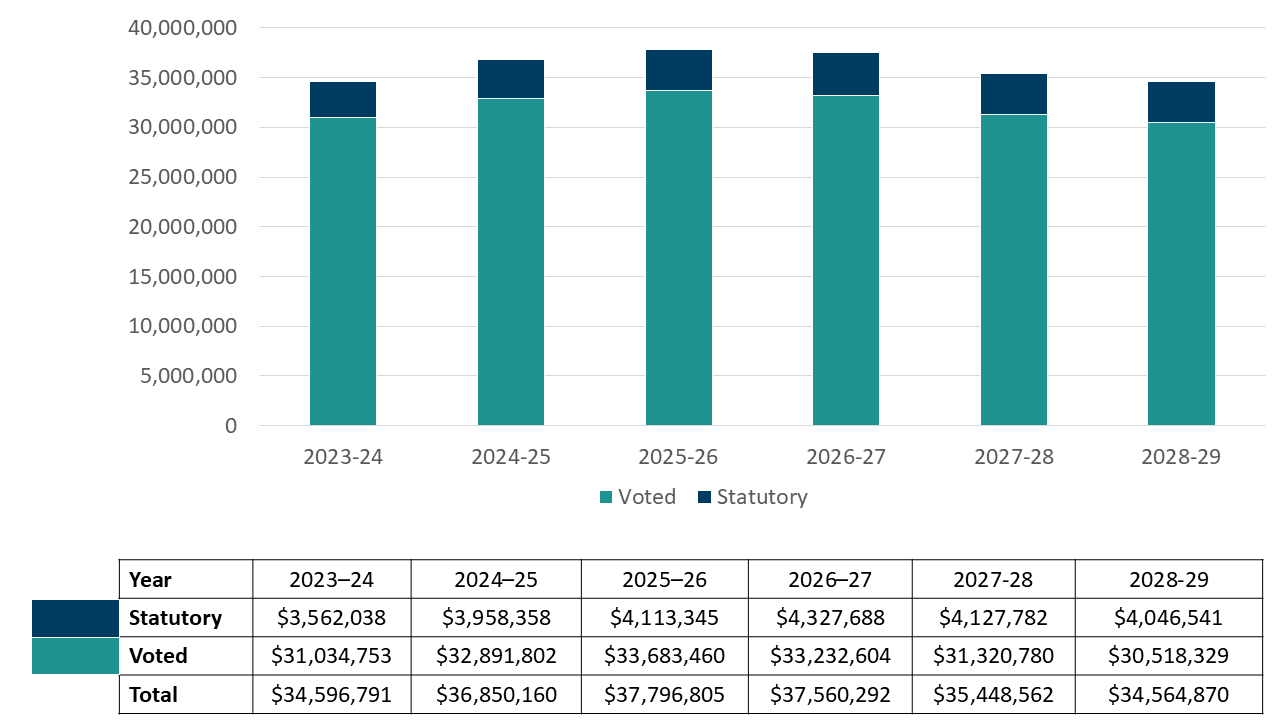
Graph 1: Approved funding (statutory and voted) over a six-year period
Graph 1 summarizes the OPC’s approved voted and statutory funding from 2023-24 to 2028-29.
Text version of Graph 1
| Fiscal year | Statutory | Voted | Total |
|---|---|---|---|
| 2023–24 | 3,562,038 | 31,034,753 | 34,596,791 |
| 2024–25 | 3,958,358 | 32,891,802 | 36,850,160 |
| 2025–26 | 4,113,345 | 33,683,460 | 37,796,805 |
| 2026–27 | 4,327,688 | 33,232,604 | 37,560,292 |
| 2027–28 | 4,127,782 | 31,320,780 | 35,448,562 |
| 2028–29 | 4,046,541 | 30,518,329 | 34,564,870 |
Analysis of statutory and voted funding over a six-year period
The above graph illustrates the OPC’s funding trend over a six-year period, from 2023-24 to 2028-29.
Statutory spending covers annual costs for employee benefits.
Such costs may vary from year to year and are set by the Treasury Board of Canada Secretariat, based on calculated expenses and forecasts.
The figures for the 2023-24 and 2024-25 fiscal years reflect the organization’s actual expenditures, as reported in the public accounts. The figures for the 2025-26 to 2028-29 fiscal years represent planned spending.
For further information on OPC’s departmental appropriations, consult the 2026-27 Main Estimates.
Future-oriented condensed statement of operations
The future-oriented condensed statement of operations provides an overview of the OPC’s operations for 2025-26 to 2026-27.
Table 9: Future-oriented condensed statement of operations for the year ended March 31, 2027 (dollars)
Table 9 summarizes the expenses and revenues which net to the cost of operations before government funding and transfers for 2025-26 to 2026-27. The forecast and planned amounts in this statement of operations were prepared on an accrual basis. The forecast and planned amounts presented in other sections of the Departmental Plan were prepared on an expenditure basis. Amounts may therefore differ.
| Financial information | 2025-26 Forecast results | 2026-27 Planned results | Difference (Planned results minus forecasted) |
|---|---|---|---|
| Total expenses | 42,461,000 | 42,119,000 | (342,000) |
| Total revenues | 156,000 | 200,000 | 44,000 |
| Net cost of operations before government funding and transfers | 42,305,000 | 41,919,000 | (386,000) |
Analysis of forecasted and planned results
The net cost of operations before government funding and transfers for the 2026-27 planned results is expected to decrease by $0.4 million when compared to the net cost of operations before government funding and transfers for the 2025-26 forecast results.
This decrease is mainly explained by the end of temporary funding received through Budget 2023, namely the funding received to reduce the backlog of privacy complaints and to undertake more in-depth investigations of privacy breaches.
A more detailed Future-Oriented Statement of Operations and associated Notes for 2026-27, including a reconciliation of the net cost of operations with the requested authorities, is available on the OPC’s website.
Human resources
This section presents an overview of the OPC’s actual and planned human resources from 2023-24 to 2028-29.
Table 10: Actual human resources for core responsibilities and internal services
Table 10 shows a summary of human resources, in full-time equivalents, for the OPC’s core responsibilities and for its internal services for the previous three fiscal years. Human resources for the 2025-26 fiscal year are forecasted based on year to date.
| Core responsibilities and internal services | 2023-24 Actual full-time equivalents | 2024-25 Actual full-time equivalents | 2025-26 Forecasted full-time equivalents |
|---|---|---|---|
| Protection and Promotion of Privacy Rights | 147 | 171 | 180 |
| Subtotal | 147 | 171 | 180 |
| Internal services | 56 | 58 | 57 |
| Total | 203 | 229 | 237 |
Analysis of human resources over the last three years
The increase in actual full-time equivalents between 2023-24 and 2025-26 is mainly attributable to resources received through Budget 2023 to reduce the backlog of privacy complaints and to undertake more in-depth investigations of privacy breaches and to the temporary funding received through Budget 2023 for preparation activities required to implement the Consumer Privacy Protection Act that was proposed as part of Bill C-27.
Table 11: Human resources planning summary for core responsibilities and internal services
Table 11 shows information on human resources, in full-time equivalents, for each of the OPC’s core responsibilities and for its internal services planned for the next three years.
| Core responsibilities and internal services | 2026-27 Planned full-time equivalents | 2027-28 Planned full-time equivalents | 2028-29 Planned full-time equivalents |
|---|---|---|---|
| Protection and Promotion of Privacy Rights | 172 | 163 | 159 |
| Subtotal | 172 | 163 | 159 |
| Internal services | 59 | 57 | 56 |
| Total | 231 | 220 | 215 |
Analysis of human resources for the next three years
The reduction in planned full-time equivalents for the 2026-27 fiscal year and beyond, compared to the past few years, is primarily due to the scheduled changes to the established funding profile related to the Consumer Privacy Protection Act sunsetting funding.
Supplementary information tables
The following supplementary information table is available on the OPC’s website:
Federal tax expenditures
The OPC’s Departmental Plan does not include information on tax expenditures.
The tax system can be used to achieve public policy objectives through the application of special measures such as low tax rates, exemptions, deductions, deferrals and credits. The Department of Finance Canada publishes cost estimates and projections for these measures each year in the Report on Federal Tax Expenditures.
This report also provides detailed background information on tax expenditures, including descriptions, objectives, historical information and references to related federal spending programs as well as evaluations and GBA Plus of tax expenditures.
Corporate information
Departmental profile
Appropriate ministerFootnote1: Sean Fraser
Institutional head: Philippe Dufresne
Ministerial portfolioFootnote2: Department of Justice Canada
Enabling instrument(s): Privacy Act, R.S.C. 1985, c. P-21; Personal Information Protection and Electronic Documents Act, S.C. 2000, c. 5
Year of incorporation / commencement: 1982
Departmental contact information
Mailing address:
Office of the Privacy Commissioner of Canada
30 Victoria Street, 1st Floor
Gatineau, Quebec K1A 1H3
Canada
Telephone: 819-994-5444
TTYFootnote3: 819-994-6591
Website(s): www.priv.gc.ca
Definitions
List of terms
- appropriation (crédit)
- Any authority of Parliament to pay money out of the Consolidated Revenue Fund.
- budgetary expenditures (dépenses budgétaires)
- Operating and capital expenditures; transfer payments to other levels of government, departments or individuals; and payments to Crown corporations.
- core responsibility (responsabilité essentielle)
- An enduring function or role performed by a department. The intentions of the department with respect to a core responsibility are reflected in one or more related departmental results that the department seeks to contribute to or influence.
- Departmental Plan (plan ministériel)
- A report on the plans and expected performance of an appropriated department over a 3 year period. Departmental Plans are usually tabled in Parliament each spring.
- departmental result (résultat ministériel)
- A consequence or outcome that a department seeks to achieve. A departmental result is often outside departments’ immediate control, but it should be influenced by program-level outcomes.
- departmental result indicator (indicateur de résultat ministériel)
- A quantitative measure of progress on a departmental result.
- departmental results framework (cadre ministériel des résultats)
- A framework that connects the department’s core responsibilities to its departmental results and departmental result indicators.
- Departmental Results Report (rapport sur les résultats ministériels)
- A report on a department’s actual accomplishments against the plans, priorities and expected results set out in the corresponding Departmental Plan.
- full-time equivalent (équivalent temps plein)
- A measure of the extent to which an employee represents a full person-year charge against a departmental budget. For a particular position, the full-time equivalent figure is the ratio of number of hours the person actually works divided by the standard number of hours set out in the person’s collective agreement.
- gender-based analysis plus (GBA Plus) (analyse comparative entre les sexes plus [ACS Plus])
-
Is an analytical tool used to support the development of responsive and inclusive policies, programs, and other initiatives. GBA Plus is a process for understanding who is impacted by the issue or opportunity being addressed by the initiative; identifying how the initiative could be tailored to meet diverse needs of the people most impacted; and anticipating and mitigating any barriers to accessing or benefitting from the initiative. GBA Plus is an intersectional analysis that goes beyond biological (sex) and socio-cultural (gender) differences to consider other factors, such as age, disability, education, ethnicity, economic status, geography (including rurality), language, race, religion, and sexual orientation.
Using GBA Plus involves taking a gender- and diversity-sensitive approach to our work. Considering all intersecting identity factors as part of GBA Plus, not only sex and gender, is a Government of Canada commitment.
- government priorities (priorités gouvernementales)
- For the purpose of the 2026-27 Departmental Plan, government priorities are the high-level themes outlining the government’s agenda in the 2025 Speech from the Throne.
- horizontal initiative (initiative horizontale)
- An initiative where two or more federal departments are given funding to pursue a shared outcome, often linked to a government priority.
- Indigenous business (entreprise autochtone)
- Requirements for verifying Indigenous businesses for the purposes of the departmental result report are available through the Indigenous Services Canada Mandatory minimum 5% Indigenous procurement target website.
- non-budgetary expenditures (dépenses non budgétaires)
- Non-budgetary authorities that comprise assets and liabilities transactions for loans, investments and advances, or specified purpose accounts, that have been established under specific statutes or under non-statutory authorities in the Estimates and elsewhere. Non-budgetary transactions are those expenditures and receipts related to the government’s financial claims on, and obligations to, outside parties. These consist of transactions in loans, investments and advances; in cash and accounts receivable; in public money received or collected for specified purposes; and in all other assets and liabilities. Other assets and liabilities, not specifically defined in G to P authority codes are to be recorded to an R authority code, which is the residual authority code for all other assets and liabilities.
- performance (rendement)
- What a department did with its resources to achieve its results, how well those results compare to what the department intended to achieve, and how well lessons learned have been identified.
- performance indicator (indicateur de rendement)
- A qualitative or quantitative means of measuring an output or outcome, with the intention of gauging the performance of a department, program, policy or initiative respecting expected results.
- plan (plan)
- The articulation of strategic choices, which provides information on how a department intends to achieve its priorities and associated results. Generally, a plan will explain the logic behind the strategies chosen and tend to focus on actions that lead to the expected result.
- planned spending (dépenses prévues)
-
For Departmental Plans and Departmental Results Reports, planned spending refers to those amounts presented in Main Estimates.
A department is expected to be aware of the authorities that it has sought and received. The determination of planned spending is a departmental responsibility, and departments must be able to defend the expenditure and accrual numbers presented in their Departmental Plans and Departmental Results Reports.
- program (programme)
- Individual or groups of services, activities or combinations thereof that are managed together within the department and focus on a specific set of outputs, outcomes or service levels.
- program inventory (répertoire des programmes)
- Identifies all the department’s programs and describes how resources are organized to contribute to the department’s core responsibilities and results.
- result (résultat)
- A consequence attributed, in part, to a department, policy, program or initiative. Results are not within the control of a single department, policy, program or initiative; instead they are within the area of the department’s influence.
- statutory expenditures (dépenses législatives)
- Expenditures that Parliament has approved through legislation other than appropriation acts. The legislation sets out the purpose of the expenditures and the terms and conditions under which they may be made.
- target (cible)
- A measurable performance or success level that a department, program or initiative plans to achieve within a specified time period. Targets can be either quantitative or qualitative.
- voted expenditures (dépenses votées)
- Expenditures that Parliament approves annually through an appropriation act. The vote wording becomes the governing conditions under which these expenditures may be made.
- Date modified: