

Office of the Privacy Commissioner of Canada’s 2024–25 Departmental results report
(Original signed by)
The Honourable Sean Fraser, P.C., K.C., M.P.
Minister of Justice and Attorney General of Canada
On this page
- At a glance
- From the Privacy Commissioner of Canada
- Results – what we achieved
- Spending and human resources
- Supplementary information tables
- Federal tax expenditures
- Corporate information
- Definitions
- Footnotes
Copyright information
© His Majesty the King in Right of Canada, as represented by
the Minister of Justice and Attorney General of Canada, 2025
Catalogue Number IP51-7E-PDF
ISSN: 2560-9777
Aussi disponible en français sous le titre : Rapport sur les résultats ministériels 2024-2025
At a glance
This departmental results report details the OPC’s actual accomplishments against the plans, priorities and expected results outlined in its 2024–25 Departmental Plan.
Key priorities
In 2024–25, the Office continued to fulfill its core responsibility as detailed in its 2024–25 Annual report to Parliament and worked to achieve its departmental results, guided by its three strategic priorities as outlined in its multi-year strategic plan:
- Protecting and promoting privacy with maximum impact by optimizing its resources and making sure that it maintains an agile structure and processes that are responsive to the needs of Canadians, using business intelligence to identify trends that need attention, producing focused guidance and outreach, leveraging strategic partnerships, and preparing for the implementation of potential new privacy legislation;
- Addressing and advocating for privacy in this time of technological change with a focus on artificial intelligence (AI) and generative AI, the proliferation of which brings both potential benefits, and increased risks to privacy; and
- Championing children’s privacy rights to ensure that their unique privacy needs are met, and that they can exercise their rights.
Highlights for OPC in 2024–25
- Total actual spending (including internal services): $36,850,160
- Total full-time equivalent staff (including internal services): 229
For complete information on the OPC’s total spending and human resources, read the Spending and human resources section of its full departmental results report.
Summary of results
The following provides a summary of the results the department achieved in 2024–25 under its main areas of activity, called “core responsibilities.”
Core responsibility 1: Protection of Privacy Rights
Actual spending: $26,905,427
Actual full-time equivalent staff: 171
In 2024–25, the OPC continued to protect and promote privacy in Canada by advancing its three strategic priorities and working toward the departmental results outlined above through the following initiatives:
- conducted an internal strategic review, resulting in a major reorganization and transformation to refine its approach, streamline its activities and focus on achieving more efficient outcomes for Canadians.
- led high-impact investigations into breaches affecting a large number of Canadians such as those at Ticketmaster, the Canada Revenue Agency, and 23andMe.
- advanced public awareness and understanding of privacy issues, and worked to deepen its understanding of youth privacy through research and engagement.
- continued to provide input to Parliament on proposed legislation and participated in studies implicating privacy.
- collaborated with other regulators on joint investigations, joint statements and resolution; and worked closely with domestic and international counterparts to develop a regulatory approach to one of the most important challenges of our time: the impact of technology, particularly AI, on privacy.
- launched an internal AI strategy to evaluate how the OPC can leverage AI to advance its own internal workflows, with the goal of setting an example for how AI can be adopted safely and responsibly.
For more information on OPC’s work under its Core Responsibility – Protection of Privacy Rights, read the Results – what we achieved section of its departmental results report.
From the Privacy Commissioner of Canada

I am pleased to present the Departmental Results Report of the Office of the Privacy Commissioner of Canada (OPC) for the fiscal year ending March 31, 2025.
An important initiative this past fiscal year was an examination of our internal processes and structures in order to optimize our programs and services to better respond to the needs of Canadians.
To that end, in January I unveiled a transformation plan marking the beginning of a change journey to a modernized OPC that delivers on its mandate and strategic priorities in the most efficient and impactful way possible.
The changes will build greater collaboration and cohesion across the Office and streamline processes, ultimately supporting more integrated, agile, and strategic approaches that will maximize the OPC’s impact in protecting and promoting individuals’ fundamental right to privacy. The changes also resulted in a 10% reduction in the number of executive positions at the OPC.
The OPC also continued to focus its efforts on advancing the three strategic priorities outlined in my strategic plan: maximizing the impact of the OPC, addressing and advocating for privacy in this time of technological change, and championing children’s privacy rights.
The transformation plan is a key initiative to support the first priority to maximize impact. So too are my Office’s efforts to strengthening collaboration with domestic and international privacy authorities and other regulatory institutions to address a wide range of issues and amplify our collective impact.
Notable examples of collaboration include joining G7 data protection and privacy authorities in endorsing statements on the role of data protection and privacy authorities in fostering trustworthy artificial intelligence (AI), and on child-appropriate AI. In addition, the OPC, along with provincial and territorial regulators, issued resolutions on deceptive design and sharing information in cases of intimate-partner violence.
The OPC and 25 privacy enforcement authorities from across Canada and around the world participated in the Global Privacy Enforcement Network’s (GPEN) privacy sweep, which focused on how online deceptive design patterns can be used to steer users towards options that may result in the unnecessary collection of more of their personal information. For the first time, the sweep was coordinated with the International Consumer Protection and Enforcement Network, which represents consumer protection authorities, including Canada’s Competition Bureau. The collaboration between the networks underscores the growing intersection between privacy and other regulatory spheres.
In May 2024, I assumed the role of Chair of the Canadian Digital Regulators Forum. Comprised of the Canadian Radio-television and Telecommunications Commission, the Competition Bureau, the Copyright Board of Canada, and the OPC, the Forum has continued to grow its knowledge and understanding of the impacts of AI and how the technology may affect each of the members’ regulatory spheres. Forum members collectively researched and developed a report on synthetic media – content generated by AI, including deepfakes.
The OPC also undertook a number of initiatives to support children’s privacy. This included research to better understand the privacy issues being experienced by young people and the privacy concerns and needs of parents and teachers in Canada, and applying a children’s privacy lens to our enforcement activities, for example in an investigation into TikTok. I also endorsed a joint statement on age assurance issued by the UK Information Commissioner, which sets out principles intended to support age assurance that is accurate and effective, while ensuring user privacy.
The OPC’s work to support compliance with privacy laws last year included the launch of a joint investigation with the UK Information Commissioner into a data breach at the global direct-to-consumer genetic testing company 23andMe. At a time when personal information flows across borders at unprecedented volumes and speed, exchanging information and working together across our respective domains and jurisdictions is essential.
In July 2024, my Office launched an investigation into Ticketmaster following a cybersecurity incident that impacted the personal information of millions of individuals worldwide. In October 2024, the OPC also began an investigation into cyberattacks at the Canada Revenue Agency that led to more than 30,000 privacy breaches dating back to 2020.
Throughout the year, the OPC offered advice and tools to institutions and organizations to support their compliance with privacy laws. This included the launch of a new online tool to help businesses and federal institutions that experience a privacy breach assess whether the breach is likely to create a real risk of significant harm to individuals.
Although Bill C-27, which would have modernized Canada’s federal private-sector privacy law, died on the Order Paper when the last federal election was called, I am confident that law reform will again become a legislative priority in the 45th Parliament. Prioritizing privacy helps create conditions for a resilient Canadian economy and a more secure and enriching digital society.
I will continue to advocate for modernized laws that recognize privacy as a fundamental right, advance the public interest, and foster a strong Canadian economy.
I am proud of all that the OPC has accomplished to protect Canadians’ fundamental right to privacy. It has been my goal to ensure that my Office is well-positioned to maximize efforts to protect Canadians in an increasingly complex and evolving digital world, and I look forward to what is to come in the year ahead as a modernized OPC.
(Original signed by)
Philippe Dufresne
Privacy Commissioner of Canada
Results – what we achieved
Core responsibilities and internal services
Core responsibility 1: Protection of Privacy Rights
Description
Ensure the protection of privacy rights of Canadians; enforce privacy obligations by federal government institutions and private-sector organizations; provide advice to Parliament on potential privacy implications of proposed legislation and government programs; promote awareness and understanding of rights and obligations under federal privacy legislation.
Quality of life impacts
The OPC is committed to incorporating the Quality of Life Framework for Canada considerations into its work wherever possible. The Protection of Privacy Rights contributes to the Prosperity (future outlook) and Good Governance (confidence in institutions) domains. Strengthened privacy protection promotes trust in the growing digital economy and directly increases Canadians’ confidence and trust in the federal government and businesses. The OPC’s policies and program activities are also informed and developed through intersectional lenses such as fairness, inclusion, and sustainability.
Progress on results
This section details the OPC’s performance against its targets for each departmental result under Core responsibility 1: Protection of Privacy Rights.
Table 1: Privacy rights are respected and obligations are met
Table 1 shows the target, the date to achieve the target and the actual result for each indicator under Privacy rights are respected and obligations are met in the last three fiscal years.
| Departmental Result Indicator | Target | Date to achieve target | Actual Results |
|---|---|---|---|
| Percentage of Canadians who feel that businesses respect their privacy rights. | 90% | March 31, 2025 | 2022–23: 39% 2023–24: not a survey year 2024–25: 40% |
| Percentage of Canadians who feel that the federal government respects their privacy rights. | 90% | March 31, 2025 | 2022–23: 58% 2023–24: not a survey year 2024–25: 62% |
| Percentage of complaints responded to within service standards. | 75% | March 31, 2025 |
2022–23: 55% |
| Percentage of formal OPC recommendations implemented by departments and organizations. | 90% | March 31, 2025 |
2022–23: 86% |
Table 2: Canadians are empowered to exercise their privacy rights
Table 2 shows the target, the date to achieve the target and actual result for each indicator under Canadians are empowered to exercise their privacy rights in the last three fiscal years.
| Departmental Result Indicator | Target | Date to achieve target | Actual Results |
|---|---|---|---|
| Percentage of Canadians who feel that they know about their privacy rights. | 70% | March 31, 2025 | 2022–23: 51% 2023–24: not a survey year 2024-25: 47% |
| Percentage of key privacy issues that are the subject of information to Canadians on how to exercise their privacy rights.Footnote 1 | 90% | n/a | 2022–23: n/a 2023–24: n/a 2024–25: n/a |
| Percentage of Canadians who read OPC information and find it useful. | 70% | March 31, 2025 | 2022–23: 66% 2023–24: 68%Footnote 2 2024–25: 66% |
Table 3: Parliamentarians, and public and private sector organizations are informed and guided to protect Canadians’ privacy rights
Table 3 shows the target, the date to achieve the target and actual result for each indicator under Parliamentarians, and public and private sector organizations are informed and guided to protect Canadians’ privacy rights in the last three fiscal years.
| Departmental Result Indicator | Target | Date to achieve target | Actual Results |
|---|---|---|---|
| Percentage of OPC recommendations on privacy-relevant bills and studies that have been adopted. | 60% | March 31, 2025 | 2022–23: 55% 2023–24: 50% 2024–25: 89.5% |
| Percentage of private sector organizations that have good or excellent knowledge of their privacy obligations. | 85% | March 31, 2026 | 2022–23: not a survey year 2023–24: 88% 2024–25: not a survey year |
| Percentage of key privacy issues that are the subject of guidance to organizations on how to comply with their privacy responsibilities.Footnote 3 | 90% | n/a | 2022–23: n/a 2023–24: n/a 2024–25: n/a |
| Percentage of federal and private sector organizations that find OPC’s advice and guidance to be useful in reaching compliance. | 70% | March 31, 2025 | 2022–23: 73% 2023–24: 72%Footnote 4 2024–25: 78% |
The Results section of the Infographic for OPC’s on GC Infobase page provides additional information on results and performance related to its program inventory.
Details on results
The following section describes the results for the Protection of Privacy Rights in 2024–25 compared with the planned results set out in the OPC’s departmental plan for the year.
In 2024–25, the OPC focused its efforts on advancing its strategic priorities as outlined in its multi‑year strategic plan to have the greatest impact and contribute to its three departmental results:
Result 1: Privacy rights are respected and obligations are met
Results achieved
The OPC remained committed to providing Canadians with a strong, fair, accessible, and timely compliance process, while taking action to improve the protection of Canadians’ personal information and deliver results that make a real difference in their lives. As part of these efforts, the OPC:
- Conducted an internal strategic review, resulting in a major reorganization and transformation which will allow the OPC to respond more rapidly and effectively to emerging issues; broaden its approach to compliance; and bring stronger alignment to its policy and legal work, as well as its enforcement and advisory activities. The full transformation will take effect in 2025–26.
- Leveraged temporary funding received for 2024–25 to adequately respond to privacy breaches reported by public and private sector organizations, and to investigate privacy complaints from the public in a timely manner.
- Although the OPC did not reach its 75% target of complaints responded to within its service standards, it nonetheless improved this result over the previous two years (62% in 2024–25 compared to 50% in 2023–24, and 55% in 2022–23). It also made significant progress at reducing its ongoing overall investigative backlog from 24% to 9% over two years.
- Launched an investigation into Ticketmaster following a cybersecurity incident that affected the accounts of millions of people worldwide, launched an investigation into cyberattacks at the Canada Revenue Agency that led to more than 30,000 privacy breaches dating back to 2020, and opened a joint investigation with the United Kingdom privacy authority into a data breach at global direct-to-consumer genetic testing company 23andMe.
- Advanced major investigations into a number of matters, including TikTok and OpenAI.
- Launched an online breach-reporting form for federal institutions, and an updated form for businesses subject to PIPEDA, to make it easier to report breaches.
- Launched the Real Risk of Significant Harm (RROSH) tool, which helps businesses and federal institutions to assess whether a privacy breach creates a RROSH and must be reported to the OPC.
- Improved the efficiency and effectiveness of its activities by taking alternative approaches to full resource-intensive investigations, such as promoting compliance strategically and using different tools that are available to the OPC. This involved including a notable review of LinkedIn’s use of personal data for AI training.
- Closed 89% of PIPEDA (388) complaints and 91% of all complaints under the Privacy Act (1,194) through either early resolution or summary investigations, which are shorter investigations that conclude with a brief report or letter of findings.
- Worked to resolve instances of non-compliance, on a case-by-case basis, by issuing recommendations to federal institutions and private-sector organizations as part of its compliance activities.
- 87% of the OPC’s recommendations were accepted and implemented by organizations found to have contravened federal privacy laws.
- Surveyed Canadians to evaluate their perceptions of how businesses and federal government respect their privacy rights. Results indicated that:
- Four in ten Canadians (40%) believe that businesses respect their privacy rights, a result that has remained stable since 2022. Meanwhile, six in ten Canadians (62%) believe that the Government of Canada respects their privacy rights, reflecting a four-percentage point increase since 2022.
- Filed an application with the Federal Court to seek an order from the Court to require Aylo, one of the world’s largest operators of pornographic sites, to take steps to bring itself into compliance with Canadian privacy law and give effect to Canadians’ privacy rights.
Result 2: Canadians are empowered to exercise their privacy rights
Results achieved
The OPC contributed to advancing public awareness and understanding of privacy issues and worked to deepen its understanding of youth privacy through research and engagement. As part of these efforts, the OPC:
- Worked to raise public awareness of privacy issues and improve understanding of the rights and responsibilities of individuals and organizations under federal privacy legislation in a timely and accessible manner. To that end, the OPC:
- Coordinated the 2024 GPEN Sweep which led, among other things, to the publication of tips for individuals on how to identify the most common types of deceptive design patterns – techniques that encourage users to give away personal information online – as well as best practices for businesses to avoid deceptive design patterns.
- Issued a joint concluding statement on data scraping, with 15 other Data Protection Authorities from around the world – which sets out expectations regarding what organizations should do to ensure that individuals are protected from unlawful data scraping.
- Developed a new tip sheet with information on how to limit the risk of identity theft. This information was also shared with Canadians across the country through a radio campaign.
- Promoted educational resources for teachers through email campaigns and exhibits at events attended by educators and librarians to support young people’s privacy education.
- Reached out to individuals and businesses through its social media channels, publishing content for various awareness campaigns including Privacy Awareness Week, Cybersecurity Awareness Month, Small Business Week, Media Literacy Week, and Data Privacy Week.
- Surveyed Canadians to assess and validate their perceived knowledge of privacy rights. Results indicated that close to half of the Canadians surveyed rated their knowledge of their privacy rights as good (34%) or very good (13%). This result is consistent with past years’ results.
- Obtained feedback from Canadians who read the OPC’s information and find it useful through the OPC’s web survey tool.
- The OPC’s website is the primary communication channel between the organization and Canadians. Overall, 66% of those who responded using the web-based feedback tool in 2024–25 found the information to be useful. It is important to note that only a minority of web visitors provided feedback. The OPC also conducted a top-task survey on its website to deepen the OPC’s understanding of Canadians’ information needs and improve the web user experience.
- Conducted research to deepen the OPC’s understanding of the privacy issues being experienced by young people, including their understanding of their privacy rights and the security of their personal information. This research will help to inform our guidance and resources for individuals, federal institutions, organizations, and businesses.
- Signed a joint statement on age assurance issued by the UK Information Commissioner’s Office. The statement sets out principles intended to support age assurance that are accurate and effective, while ensuring user privacy.
- Ran an exploratory consultation on age assurance to enhance the OPC’s understanding of the benefits, concerns, and existing research or writing associated with age assurance and published a summary report. The results of this consultation will inform the preparation of draft guidance on the use and design of age-assurance systems.
Result 3: Parliamentarians, and public and private sector organizations are informed and guided to protect Canadians’ privacy rights
Results achieved
The OPC continued to provide input to Parliament on proposed legislation, participated in studies affecting privacy rights, collaborated with domestic and international regulators, and provided privacy advice to support the compliance efforts of both public and private sector organizations. As part of these efforts, the OPC:
- Advocated for the strengthening of Canada’s privacy laws to effectively recognize, promote, and protect the fundamental right to privacy while enabling responsible innovation and creating conditions for a resilient Canadian economy and a more secure and enriching digital society.
- Provided advice to Parliament on proposed legislation and studies that implicated privacy, including four submissions to Parliament and the government; and eight appearances before House of Commons or Senate committees.
- The OPC continued to monitor bills and studies going through the legislative process for which it had previously provided recommendations. Of its recommendations on bills that completed their parliamentary journey in 2024–25, 89.5% of them were adopted by Parliament.
- Welcomed the unanimous Federal Court of Appeal decision on Facebook, stating that it is an acknowledgement that international data giants must respect Canadian privacy law.
- Promoted better understanding of the rights and obligations under federal privacy legislation, through advice and recommendations to government departments and private-sector organizations. Specifically:
- Worked closely with federal law enforcement and intelligence communities, consulting and providing advice on initiatives that could impact the privacy of Canadians.
- Held 18 government advisory events, which were widely attended by representatives from across government both in the ATIP community and program areas. These events reached employees of half of all federal government departments and agencies that are covered under the Privacy Act.
- Provided advice to businesses to help them ensure that their initiatives and practices for managing personal information comply with PIPEDA by delivering advisory consultations and in‑person and virtual presentations; and held a privacy forum and privacy clinics in various regions of the country in close collaboration with innovation hubs and accelerators.
- Obtained feedback on organizations’ level of satisfaction with OPC guidance through the OPC’s web survey tool. Overall, 78% of the federal and private-sector organizations that responded were satisfied with the usefulness of guidance documents on our website.
- Contributed to advancing cooperation and advocating for greater privacy protection collaboratively with international privacy counterparts, including issuing joint statements with fellow G7 data protection and privacy authorities on fostering trustworthy AI and on AI and children.
- Launched an internal AI strategy to evaluate if and how the OPC might leverage AI to advance its own internal workflows, with the goal of setting an example for how AI can be adopted safely and responsibly.
Key risks
To stay effective amid growing environmental complexity and evolving privacy challenges, the OPC continued to enhance its agility and cost-efficiency through a major organizational transformation – amplifying its impact and driving forward its strategic priorities.
Maintaining employee engagement and well-being in the context of significant internal transformation and mitigating potential negative impacts remained a key priority as the OPC worked to support its staff through a period of significant change. Over the past year, it actively monitored and promoted employee well-being by ensuring staff was not only directly engaged and consulted but also remained well-informed throughout the Office’s reorganization and transformation.
Resources required to achieve results
Table 4: Snapshot of resources required for the Protection of Privacy Rights
Table 4 provides a summary of the planned and actual spending and full-time equivalents required to achieve results.
| Resource | Planned | Actual |
|---|---|---|
| Spending | 24,986,305 | 26,905,427 |
| Full-time equivalents | 167 | 171 |
The Finances section of the Infographic for OPC’s on GC Infobase page and the People section of the Infographic for OPC’s on GC Infobase page provide complete financial and human resources information related to its program inventory.
Related government priorities
This section highlights government priorities that are being addressed through this core responsibility.
United Nations 2030 Agenda for Sustainable Development and the Sustainable Development Goals
More information on the OPC’s contributions to Canada’s Federal Implementation Plan on the 2030 Agenda and the Federal Sustainable Development Strategy can be found in its Departmental Sustainable Development Strategy.
Innovation
The OPC Transformation Plan marks the next step towards strengthening its ability to effectively and efficiently protect and promote the fundamental right to privacy in an increasingly complex and evolving digital world.
The changes will result in greater collaboration and cohesion across the Office and streamline processes, ultimately supporting more integrated, agile and strategic approaches that will maximize the OPC’s impact for Canadians. This will include changes that will allow greater focus on its strategic priorities; respond more rapidly and effectively to emerging issues; evolve its approach to compliance; and bring stronger alignment to its policy and legal work and its enforcement and advisory activities. This has also resulted in a 10% reduction in the number of executive positions at the OPC.
The Transformation Plan reflects significant and thoughtful input that was provided from across the organization during the review, driven by a desire on the part of OPC employees to innovate.
Program inventory
The Protection of Privacy Rights is supported by the following programs:
- Compliance Program
- Promotion Program
Activities related to addressing existing compliance issues fall under the Compliance Program, while activities to bring departments and organizations towards compliance with the law fall under the Promotion Program.
Additional information related to the program inventory for the Protection of Privacy Rights is available on the Results page on GC InfoBase.
Internal services
Description
Internal services refer to the activities and resources that support a department in its work to meet its corporate obligations and deliver its programs. The 10 categories of internal services are:
- Management and Oversight Services
- Communications Services
- Legal Services
- Human Resources Management
- Financial Management
- Information Management
- Information Technology
- Real Property
- Materiel
- Acquisitions
Communications services are an integral part of the OPC’s education and outreach mandate. As such, these services are included in the Promotion Program. Legal services are for its part an integral part of the OPC’s delivery of compliance activities and they are included in the Compliance Program.
Progress on results
This section presents details on how the department performed to achieve results and meet targets for internal services.
In 2024–25, Internal Services led a major reorganization and transformation initiative to enhance organizational impact, streamline activities, and ensure alignment with long-term strategic priorities. With a broad focus on change management and adaptation—including targeted efforts to cultivate a healthy, resilient workforce—Internal Services responded effectively to the evolving needs of the OPC, delivering timely and efficient support across the organization.
To enable effective program delivery, Internal Services undertook the following key initiatives:
- developed and launched the Integrated Human Resources Plan (IHRP) 2025–30 unifying Human Resources, Employment Equity, Diversity and Inclusion, and Official Languages priorities into a single, cohesive framework. This plan is designed to help bridge the gap between current and future workforce needs, and ensure sound people management across the organization.
- strengthened the hybrid work model to ensure staff had access to modern tools that facilitated maximum flexibility and productivity in both remote and office environments.
- reviewed the training, learning, and development program to ensure alignment with the organization’s mandate and objectives.
- conducted a review of the Internal Control over Financial Reporting framework.
Resources required to achieve results
Table 5: Resources required to achieve results for internal services this year
Table 5 provides a summary of the planned and actual spending and full-time equivalents (FTEs) required to achieve results.
| Resource | Planned | Actual |
|---|---|---|
| Spending | 8,994,995 | 9,944,733 |
| Full-time equivalents | 54 | 58 |
The Finances section of the Infographic for OPC on GC Infobase and the People section of the Infographic for OPC on GC Infobase provide complete financial and human resources information related to its program inventory.
Contracts awarded to Indigenous businesses
Government of Canada departments are required to award at least 5% of the total value of contracts to Indigenous businesses every year.
Office of the Privacy Commissioner of Canada results for 2024–25
Table 6: Total value of contracts awarded to Indigenous businesses
As shown in Table 6, OPC awarded 10.7 % of the total value of all contracts to Indigenous businesses for the fiscal year. In its 2025–26 Departmental Plan, the OPC estimated that it would award 10% of the total value of its contracts to Indigenous businesses by the end of 2024–25. The OPC met its target as a significant part of our procurement was done through PSPC procurement tools that include Indigenous businesses, and we consistently invited them to participate in the processes.
| Contracting performance indicator | 2024–25 Result |
|---|---|
| Total value of contracts awarded to Indigenous businesses* (A) | $410,283 |
| Total value of contracts awarded to Indigenous and non‑Indigenous businesses** (B) | $3,818,360 |
| Value of exceptions approved by Deputy Head (C) | $0 |
| Proportion of contracts awarded to Indigenous businesses [A / (B−C) × 100] | 10.7% |
|
Spending and human resources
In this section
Spending
This section presents an overview of the department’s actual and planned expenditures from 2022–23 to 2027–28.
Refocusing Government Spending
While not officially part of this spending reduction exercise, to respect the spirit of this exercise, the OPC undertook the following measures in 2024–25.
The OPC launched a strategic review. Through research, consultation, and reflection, the Office worked to broaden its impact and sharpen its strategic priorities, focusing on maximizing the impact of the OPC, addressing the privacy implications of technology such as artificial intelligence (AI), and championing children’s privacy. This process set in motion a significant reorganization and transformation within the organization to maximize efficiencies and synergies across the Office and continue to direct resources to priority areas where it can achieve the greatest outcomes for Canadians.
Budgetary performance summary
Table 7: Actual three-year spending on core responsibilities and internal services (dollars)
Table 7 shows the money that OPC spent in each of the past three years on its core responsibilities and on internal services.
| Core responsibilities and internal services | 2024–25 Main Estimates | 2024–25 total authorities available for use | Actual spending over three years (authorities used) |
|---|---|---|---|
| Protection of privacy rights | 24,986,305 | 27,582,335 |
|
| Subtotal | 24,986,305 | 27,582,335 | 26,905,427 |
| Internal services | 8,994,995 | 10,194,931 |
|
| Total | 33,981,300 | 37,777,266 |
|
Analysis of the past three years of spending
The variance between the 2024–25 Main Estimates and the 2024–25 total authorities available for use is due to the following:
- funding received for the operating budget carry forward from 2023–24 to 2024–25;
- compensation adjustments to fund salary increases to meet obligations under new collective agreements;
- the temporary funding received as part of Budget 2023 to reduce the backlog of privacy complaints and effectively address privacy breaches across public and private organizations; and
- the temporary funding received as part of Budget 2023 for preparation activities required to implement the Consumer Privacy Protection Act proposed as part of Bill C-27.
The increase in expenses is mainly attributed to additional spending on staffing resulting from new hires, as well as salary increases, and retroactive payments made following the ratification of collective agreements over the past years.
The Finances section of the Infographic for OPC on GC Infobase offers more financial information from previous years.
Table 8: Planned three-year spending on core responsibilities and internal services (dollars)
Table 8 shows OPC’s planned spending for each of the next three years on its core responsibilities and on internal services.
| Core responsibilities and internal services | 2025–26 planned spending | 2026–27 planned spending | 2027–28 planned spending |
|---|---|---|---|
| Protection of privacy rights | 28,224,714 | 23,858,145 | 23,858,145 |
| Subtotal | 28,224,714 | 23,858,145 | 23,858,145 |
| Internal services | 10,211,069 | 8,571,353 | 8,571,353 |
| Total | 38,435,783 | 32,429,499 | 32,429,499 |
Analysis of the next three years of spending
Budgetary spending for the 2025–26 fiscal year corresponds to the OPC’s planned spending. It includes:
- funding received for the collective agreements;
- the temporary funding received to reduce the backlog of privacy complaints and effectively address privacy breaches across public and private organizations; and
- the temporary funding received as part of Budget 2023, namely the funding for preparation activities required to implement the Consumer Privacy Protection Act proposed as part of Bill C‑27.
The reduction in planned spending for the 2026–27 fiscal year and beyond is the result of the end of the above-mentioned temporary funding.
The Finances section of the Infographic for OPC on GC Infobase offers more detailed financial information related to future years.
Funding
This section provides an overview of the department’s voted and statutory funding for its core responsibilities and for internal services. Consult the Government of Canada budgets and expenditures for further information on funding authorities.
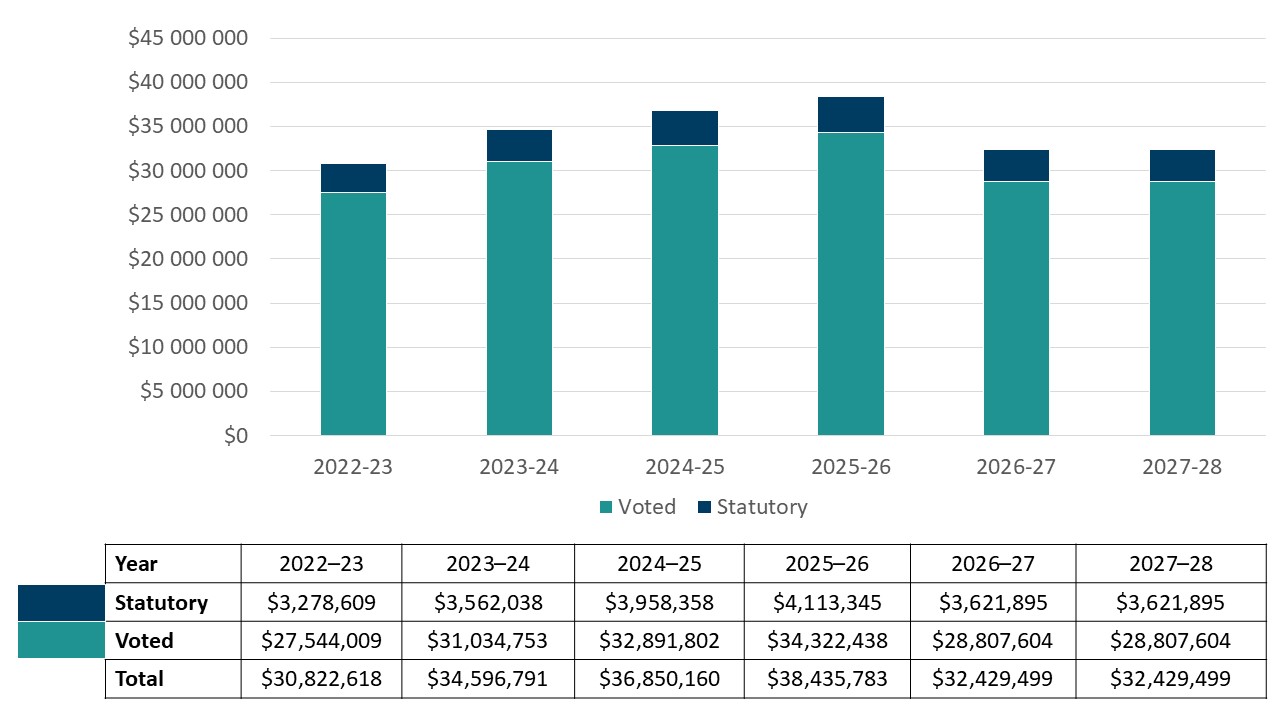
Graph 1: Approved funding (statutory and voted) over a six-year period
Graph 1 summarizes the department’s approved voted and statutory funding from 2022–23 to 2027–28.
Text version of Graph 1
Graph 1 includes the following information in a bar graph.
| Fiscal year | Statutory | Voted | Total |
|---|---|---|---|
| 2022–23 | 3,278,609 | 27,544,009 | 30,822,618 |
| 2023–24 | 3,562,038 | 31,034,753 | 34,596,791 |
| 2024–25 | 3,958,358 | 32,891,802 | 36,850,160 |
| 2025–26 | 4,113,345 | 34,322,438 | 38,435,783 |
| 2026–27 | 3,621,895 | 28,807,604 | 32,429,499 |
| 2027–28 | 3,621,895 | 28,807,604 | 32,429,499 |
Analysis of statutory and voted funding over a six-year period
The above graph illustrates the OPC’s spending trend over a six-year period from 2022–23 to 2027–28. Fiscal years 2022–23 to 2024–25 reflect the organization’s actual expenditures as reported in the Public Accounts. Fiscal years 2025–26 to 2027–28 represent planned spending.
The increased actual spending in 2024–25 and planned spending in 2025–26 is mainly attributable to salary increases, and to retroactive payments made following the ratification of collective agreements over the past years. It is also attributable to the temporary funding received in Budget 2023, namely the funding for activities required to prepare for the implementation of the Consumer Privacy Protection Act that was proposed as part of Bill C-27, and the funding received to reduce the backlog of privacy complaints and address privacy breaches. The OPC anticipates a decrease in its planned spending in 2026–27. When this temporary funding comes to an end, the OPC’s planned spending will level off at $32.4 million.
Consult the Public Accounts of Canada for further information on the OPC’s departmental voted and statutory expenditures.
Financial statement highlights
The OPC’s Financial Statements (Audited) for the Year Ended March 31, 2025, are available online.
Table 9: Condensed Statement of Operations (audited) for the year ended March 31, 2025 (dollars)
Table 9 summarizes the expenses and revenues for 2024–25 which net to the cost of operations before government funding and transfers.
| Financial information | 2024–25 actual results | 2024–25 planned results | Difference (actual results minus planned) |
|---|---|---|---|
| Total expenses | 41,640,000 | 39,111,000 | 2,529,000 |
| Total revenues | 190,000 | 200,000 | (10,000) |
| Net cost of operations before government funding and transfers | 41,450,000 | 38,911,000 | 2,539,000 |
Analysis of expenses and revenues for 2024–25
The difference between the 2024–25 actual results and the 2024–25 planned results is mainly attributable to salary increases, and to retroactive payments made following the ratification of collective agreements over the past years. It is also attributable to the temporary funding received in Budget 2023, namely the funding for activities required to prepare for the implementation of the Consumer Privacy Protection Act that was proposed as part of Bill C-27, and the funding received to reduce the backlog of privacy complaints and address privacy breaches. The 2024–25 planned results information is provided in the OPC’s Future-Oriented Statement of Operations and Notes 2024–25.
Table 10: Condensed Statement of Operations (audited) for 2023–24 and 2024–25 (dollars)
Table 10 summarizes actual expenses and revenues and shows the net cost of operations before government funding and transfers.
| Financial information | 2024–25 actual results | 2023–24 actual results | Difference (2024–25 minus 2023–24) |
|---|---|---|---|
| Total expenses | 41,640,000 | 38,498,000 | 3,142,000 |
| Total revenues | 190,000 | 238,000 | 48,000 |
| Net cost of operations before government funding and transfers | 41,450,000 | 38,260,000 | 3,190,000 |
Analysis of differences in expenses and revenues between 2023–24 and 2024–25
In 2024–25, actual spending increased from 2023–24. The increase can be attributed to an increase in personnel expenditures due to the temporary funding received in Budget 2023, namely the funding for activities required to prepare for the implementation of the Consumer Privacy Protection Act that was proposed as part of Bill C-27, and the funding received to reduce the backlog of privacy complaints and address privacy breaches. It is also attributable to increases in salary ranges and to retroactive payments made following the ratification of collective agreements over the past years.
Table 11: Condensed Statement of Financial Position (audited) as of March 31, 2025 (dollars)
Table 11 provides a brief snapshot of the amounts the department owes or must spend (liabilities) and its available resources (assets), which helps to indicate its ability to carry out programs and services.
| Financial information | Actual fiscal year (2024–25) | Previous fiscal year (2023–24) |
Difference (2024–25 minus 2023–24) |
|---|---|---|---|
| Total net liabilities | 5,634,000 | 5,755,000 | (121,000) |
| Total net financial assets | 3,652,000 | 3,905,000 | (253,000) |
| Departmental net debt | 1,982,000 | 1,850,000 | 132,000 |
| Total non-financial assets | 1,728,000 | 2,261,000 | (533,000) |
| Departmental net financial position | (254,000) | 411,000 | (665,000) |
Analysis of department’s liabilities and assets since last fiscal year
The net financial position decreased $0.7 million compared to 2023–24 due to decreases in net liabilities, net financial assets and non-financial assets. The difference in net financial assets and non-financial assets is largely due to a decrease in payables at year end, prepaid expenses and less acquisitions of tangible capital assets.
Human resources
This section presents an overview of the department’s actual and planned human resources from 2022–23 to 2027–28.
Table 12: Actual human resources for core responsibilities and internal services
Table 12 shows a summary in full-time equivalents of human resources for OPC’s core responsibilities and for its internal services for the previous three fiscal years.
| Core responsibilities and internal services | 2022–23 actual FTEs | 2023–24 actual FTEs | 2024–25 actual FTEs |
|---|---|---|---|
| Protection of privacy rights | 150 | 147 | 171 |
| Subtotal | 150 | 147 | 171 |
| Internal services | 57 | 56 | 58 |
| Total | 207 | 203 | 229 |
Analysis of human resources for the last three years
The increase in 2024–25 actual FTEs is due to the temporary funding received as part of Budget 2023 to reduce the backlog of privacy complaints and to address privacy breaches as well as the temporary funding received as part of Budget 2023 for preparation activities required to implement the Consumer Privacy Protection Act proposed as part of Bill C‑27.
Table 13: Human resources planning summary for core responsibilities and internal services
Table 13 shows the planned full-time equivalents for each of OPC’s core responsibilities and for its internal services for the next three years. Human resources for the current fiscal year are forecast based on year to date.
| Core responsibilities and internal services | 2025–26 planned FTEs | 2026–27 planned FTEs | 2027–28 planned FTEs |
|---|---|---|---|
| Protection of privacy rights | 180 | 153 | 153 |
| Subtotal | 180 | 153 | 153 |
| Internal services | 57 | 54 | 54 |
| Total | 237 | 207 | 207 |
Analysis of human resources for the next three years
The increase in 2025–26 planned FTEs is due to the temporary funding received as part of Budget 2023, namely the funding for preparation activities required to implement the Consumer Privacy Protection Act that was proposed as part of Bill C-27, and the funding received to reduce the backlog of privacy complaints and to address privacy breaches. The planned FTEs for 2026–27 and 2027–28 remain stable at 207 FTEs. The OPC will continue to achieve results by allocating its human resources to best support its priorities and programs.
Supplementary information tables
The following supplementary information tables are available on the OPC’s website:
Federal tax expenditures
The tax system can be used to achieve public policy objectives through the application of special measures such as low tax rates, exemptions, deductions, deferrals and credits. The Department of Finance Canada publishes cost estimates and projections for these measures each year in the Report on Federal Tax Expenditures. This report also provides detailed background information on tax expenditures, including descriptions, objectives, historical information and references to related federal spending programs as well as evaluations and GBA Plus of tax expenditures.
Corporate information
Departmental profile
Appropriate ministerFootnote 5: Sean Fraser
Institutional head: Philippe Dufresne
Ministerial portfolioFootnote 6: Department of Justice Canada
Enabling instrument(s): Privacy Act, R.S.C. 1985, c. P-21; Personal Information Protection and Electronic Documents Act, S.C. 2000, c. 5
Year of incorporation / commencement: 1982
Departmental contact information
Mailing address:
Office of the Privacy Commissioner of Canada
30 Victoria Street, 1st Floor
Gatineau, Quebec K1A 1H3
Canada
Telephone: 819-994-5444
Toll-free: 1-800-282-1376
TTYFootnote 7: 819-994-6591
Website(s): www.priv.gc.ca
Definitions
Definitions
appropriation (crédit)
Any authority of Parliament to pay money out of the Consolidated Revenue Fund.
budgetary expenditures (dépenses budgétaires)
Operating and capital expenditures; transfer payments to other levels of government, departments or individuals; and payments to Crown corporations.
core responsibility (responsabilité essentielle)
An enduring function or role of a department. The departmental results listed for a core responsibility reflect the outcomes that the department seeks to influence or achieve.
Departmental Plan (plan ministériel)
A report that outlines the anticipated activities and expected performance of an appropriated department over a 3-year period. Departmental Plans are usually tabled in Parliament in spring.
departmental priority (priorité)
A plan, project or activity that a department focuses and reports on during a specific planning period. Priorities represent the most important things to be done or those to be addressed first to help achieve the desired departmental results.
departmental result (résultat ministériel)
A high-level outcome related to the core responsibilities of a department.
departmental result indicator (indicateur de résultat ministériel)
A quantitative or qualitative measure that assesses progress toward a departmental result.
departmental results framework (cadre ministériel des résultats)
A framework that connects the department’s core responsibilities to its departmental results and departmental result indicators.
Departmental Results Report (rapport sur les résultats ministériels)
A report outlining a department’s accomplishments against the plans, priorities and expected results set out in the corresponding Departmental Plan.
Full-time equivalent (équivalent temps plein)
Measures the person years in a departmental budget. An employee’s scheduled hours per week divided by the employer’s hours for a full-time workweek calculates a full-time equivalent. For example, an employee who works 20 hours in a 40-hour standard workweek represents a 0.5 full-time equivalent.
Gender-based Analysis Plus (GBA Plus) (analyse comparative entre les sexes plus [ACS Plus])
An analytical tool that helps to understand the ways diverse individuals experience policies, programs and other initiatives. Applying GBA Plus to policies, programs and other initiatives helps to identify the different needs of the people affected, the ways to be more responsive and inclusive, and the methods to anticipate and mitigate potential barriers to accessing or benefitting from the initiative. GBA Plus goes beyond biological (sex) and socio-cultural (gender) differences to consider other factors, such as age, disability, education, ethnicity, economic status, geography (including rurality), language, race, religion, and sexual orientation.
government priorities (priorités pangouvernementales)
For the purpose of the 2024–25 Departmental Results Report, government priorities are the high-level themes outlining the government’s agenda as announced in the 2021 Speech from the Throne.
horizontal initiative (initiative horizontale)
A program, project or other initiative where two or more federal departments receive funding to work collaboratively on a shared outcome usually linked to a government priority, and where the ministers involved agree to designate it as horizontal. Specific reporting requirements apply, including that the lead department must report on combined expenditures and results.
Indigenous business (entreprise autochtone)
For the purposes of a Departmental Result Report, this includes any entity that meets the Indigenous Services Canada’s criteria of being owned and operated by Elders, band and tribal councils, registered in the Indigenous Business Directory or registered on a modern treaty beneficiary business list.
non‑budgetary expenditures (dépenses non budgétaires)
Net outlays and receipts related to loans, investments and advances, which change the composition of the financial assets of the Government of Canada.
performance (rendement)
What a department did with its resources to achieve its results, how well those results compare to what the department intended to achieve, and how well lessons learned have been identified.
performance indicator (indicateur de rendement)
A qualitative or quantitative measure that assesses progress toward a departmental-level or program-level result, or the expected outputs or outcomes of a program, policy or initiative.
plan (plan)
The articulation of strategic choices, which provides information on how a department intends to achieve its priorities and associated results. Generally, a plan will explain the logic behind the strategies chosen and tend to focus on actions that lead to the expected result.
planned spending (dépenses prévues)
For Departmental Plans and Departmental Results Reports, planned spending refers to the amounts presented in Main Estimates. Departments must determine their planned spending and be able to defend the financial numbers presented in their Departmental Plans and Departmental Results Reports.
program (programme)
An individual, group, or combination of services and activities managed together within a department and focused on a specific set of outputs, outcomes or service levels.
program inventory (répertoire des programmes)
A listing that identifies all the department’s programs and the resources that contribute to delivering on the department’s core responsibilities and achieving its results.
result (résultat)
An outcome or output related to the activities of a department, policy, program or initiative.
statutory expenditures (dépenses législatives)
Spending approved through legislation passed in Parliament, other than appropriation acts. The legislation sets out the purpose and the terms and conditions of the expenditures.
target (cible)
A quantitative or qualitative, measurable goal that a department, program or initiative plans to achieve within a specified time period.
voted expenditures (dépenses votées)
Spending approved annually through an appropriation act passed in Parliament. The vote also outlines the conditions that govern the spending.
- Date modified: