

Youth Summit on the Best Interests of the Child in the Digital Environment: Preliminary Report
February 2026 – Ottawa (ON)
Collaboration between the Office of the Privacy Commissioner of Canada,
the eQuality Project at the University of Ottawa, and
the Kids Play Tech Lab at McGill University
Co-PIs: Valerie Steeves and Sara M. Grimes
Research Assistants: Celine Huang, Ashley Poon, Rhys Traynor, Amber Wahl, and Ella Whittall
Data visualization: Robbie Lariviere
Introduction
In the summer of 2025, the Office of the Privacy Commissioner (OPC) of Canada launched an exploratory consultation on a proposed Children’s Privacy Code. In keeping with Article 12 of the United Nations Convention on the Rights of the Child (UNCRC), which requires that adults take account of children’s views when making decisions that impact them, a team of researchers held a two-day youth summit in November 2025 to consult with 24 young people between the ages of 9 and 17 years from the greater Ottawa/Gatineau area about their experiences and opinions on a range of issues related to online privacy, best interests, and other rights in the digital environment.
Together, we came up with a list of 8 priority areas or “Key Interests” that the research team will use as the basis for a set of policy recommendations aimed at informing future Canadian laws, regulations, and guidelines that better reflect children’s voices and work to advance children’s rights online. This quick report provides a sneak peek of that list and other preliminary findings. A full report of findings and recommendations will be shared once the data analysis is complete.
Youth Summit
Each day included a mix of presentations, full group plenary discussions, creative activities, and small focus group discussions (each involving 6 participants and 2 members of the research team). The event was designed to answer three research questions:
- What things do young people identify as in their best interests in the digital environment?
- What things do young people identify as working against their best interests in a networked environment?
- Do young people feel the four elements in the OPC’s description of a (potential) Children’s Privacy Code will help advance their best interests?
Day 1 focused on finding out what the participants considered their best interests when they use or encounter digital technologies: i) at school, ii) on social/streaming media platforms, and iii) in digital games and play. We discussed each one of these domains separately, followed by a “create and tell” activity aimed at summarizing their conclusions about what works (good experience or example) and what doesn’t (bad experience or example) in that particular domain (Illustration 1). Some participants also used the creative activities as a first draft of visuals to add to the graffiti wall (Illustration 2).

Illustration 1
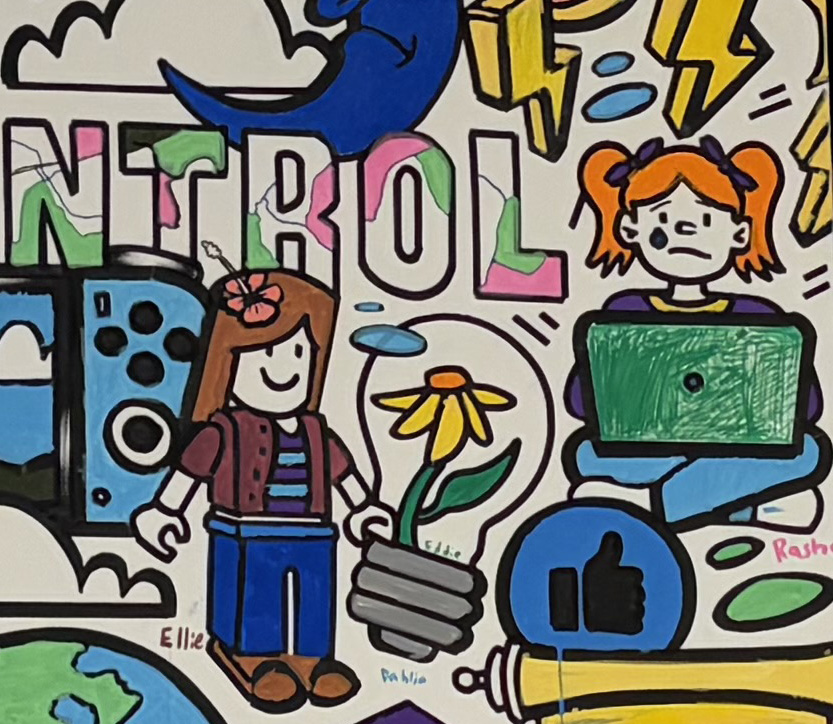
Illustration 2

Illustration 3
In the final session of Day 1, participants were asked to write down the most important keywords or themes of the day’s discussions on sticky notes and use them to create two “word clouds” to show which ones represented children’s “best interests” and which ones worked against their interests (depicted in Illustration 3).
Eight “Key Interests”
On Day 2, the research team presented 10 key recurring themes, based on a preliminary analysis of the Day 1 discussions and the sticky note word clouds. Participants then discussed the suitability of the 10 themes as possible priority areas for policymaking that support children’s privacy, rights and best interests; ranked them in order of importance, and in some cases proposed alternatives. The revised results were subsequently shared in a full group plenary session, where a list of 8 key themes or “interests” was finalized.
| Interest | Preliminary Description |
| 1. Access to technology |
|
| 2. Private spaces for personal relationships, thoughts, and exploration |
|
| 3. Supervision not surveillance |
|
| 4. Access to reliable information |
|
| 5. Children’s data must not be used to manipulate them |
|
| 6. Transparency about data practices and rules that is effectively communicated to children and young people |
|
| 7. Deleting data |
|
| 8. Control and consent |
|
Notably, the initial proposed list of ten overarching themes included a separate entry for “education,” as many participants expressed concern about what they saw as a widespread lack of awareness and literacy about the data practices of companies and other organizations and about privacy laws and children’s privacy rights, on the part of children, parents, teachers, and—significantly—companies themselves. Notably, education and literacy were also associated with various other themes and interests, particularly those that hinged on users knowing about their rights and how to exert them (e.g. deleting data). This complex theme will be revisited in the data analysis stage. In the meantime, it might be considered a “cross-cutting” interest that was clearly important to many of the children who participated in the summit.
Data Visualization
Throughout the Youth Summit, the participants’ insights, artwork and suggestions were represented or summarized visually (illustrations) by a local artist in the form of a “graffiti wall” that participants could see unfold and contribute to over the course of the two days. The resulting community-art mural serves as a data visualization of the children’s high-level contributions to the Summit and will eventually be displayed in the lobby of the Office of the Privacy Commissioner of Canada (see Illustration 4).
An interpretive analysis of the mural will be conducted during the data analysis stage to get a better sense of the patterns, representations, and omissions when compared to responses shared during the small group discussions and individual creative activities.
However, a few preliminary recurring themes can already be observed. We note repeat representations of the “good” and “bad,” or good vs. bad. We also note that the robotic hand at the bottom of the middle panel, which was drawn before the start of the summit was echoed with a second robot labeled AI. It will be interesting to uncover if and how AI technologies were discussed by participants during the small (focus) group sessions.
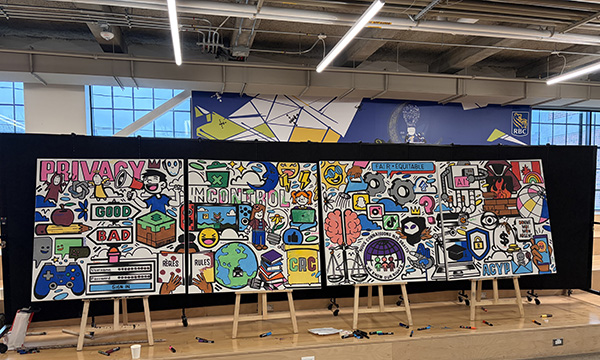
Illustration 4
Alignment with Resolution on the Best Interests of the Child
OPC’s call for public feedback on a Children’s Privacy Code includes references and principles articulated in the 2023 Resolution of the Federal, Provincial and Territorial Privacy Commissioners and Ombuds with Responsibility for Privacy Oversight on “Putting best interests of young people at the forefront of privacy and access to personal information,” and its companion document. On Day 2 of the Summit, participants were introduced to the four provisions in the Resolution, including proposals to restrict i) tracking and ii) deceptive practices, to iii) limit third party disclosure, and to iv) ensure that children can delete their online content when they wish to do so.
Using a yarn and pushpins activity to guide the discussion and debate, participants were invited to conceptually and materially draw linkages, if any, between the key themes and each of the four provisions (see Illustration 5).
They were also invited to add sticky notes from the Day 1 “word clouds” to either contextualize their linkages or add additional themes to their “map.” The yarn maps were then discussed in plenary. Preliminary recommendations include the following:
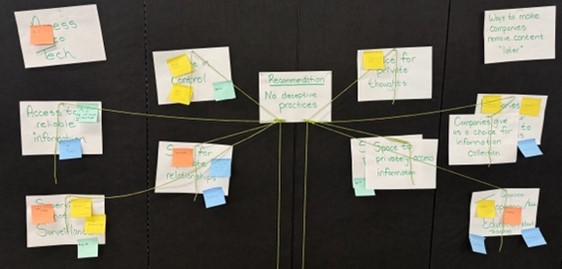
Illustration 5
- Turn off tracking and profiling: Children “have a right to not be tracked or profiled without justification, knowledge or consent.”
While participants had not identified “no tracking” among their top concerns, they did think that a rule prohibiting covert tracking would contribute to the advancement of 6 of the 8 agreed upon “Key Interests,” including #3 (Supervision not surveillance), #1 (Access to technology), #2 (Spaces for private relationships and thoughts), #5 (Children’s data must not be used to manipulate them), #6 (Transparency), and #8 (Control and consent). - Reject deceptive practices: “Young people must not be influenced or coerced into making privacy-related decisions contrary to their interests.”
This principle shares important commonalities with Key Interest #5 (Children’s data must not be used to manipulate them). During the yarn mapping activity, participants linked the “no deception” principle to this and to five other “Key Interests,” including #2 (Spaces for private relationships, thoughts, identity), #3 (Supervision not surveillance), #4 (Access to reliable information), #6 (Transparency), and #8 (Control and consent). - Limiting disclosure of children’s information: “There must be clear limits to sharing and uses of young people’s personal information.”
This principle similarly reflected many of the experiences and questions raised in our small group discussions, with some participants expressing feeling uncomfortable, uninformed and/or unable to control how their data was shared with third parties or for secondary uses. The participants linked this principle with 6 of the Key Interests, including #8 (Control and consent), #2 (Spaces for private thoughts and identity), #3 (Supervision not surveillance), #4 (Access to reliable information), #5 (Children’s data must not be used to manipulate them), and #7 (Deleting data). - Allow for deletion or deindexing and limiting retention: Children “should have the ability to correct errors with their personal information and a means to reinvent themselves as they mature and enter adulthood.”
This principle relates directly to Key Interest #7 (Deleting data), which similarly asserts that children should be able to delete their data. However, summit participants expressed wanting even broader rights to deletion, with some proposing that companies should be required to comply with requests to delete children’s data when asked, even if significant time has passed since the data was collected. Participants in the yarn mapping activity also link this principle with 5 other Key Interests including #1 (Access to technology), #2 (Spaces for private relationships, thoughts, and identity), #3 (Supervision not surveillance), #4 (Access to reliable information), and #8 (Control and consent).
Overall, the principles were well received by the participants and reflected a majority of the themes identified as Key Interests of children in regard to privacy, best interests, and other rights in the digital environment. Notably all 8 of the Key Interests were linked by participants to at least two of the four principles.
Next Steps
A detailed (full) report of our findings will be shared once the data analysis is complete. We also plan to translate relevant findings and insights into a set of policy recommendations that reflect the participants’ diverse experiences, priorities, and concerns. We will share these recommendations with the OPC, as well as other policymakers and stakeholders, in the form of an open-access downloadable PDF that will be distributed online and across relevant networks when ready.
- Date modified: