

Office of the Privacy Commissioner of Canada’s 2025–26 Departmental Results Report
(Original signed by)
The Honourable Sean Fraser, P.C., K.C., M.P.
Minister of Justice and Attorney General of Canada
On this page
Copyright information
© His Majesty the King in Right of Canada, as represented by the Minister of Justice and Attorney General of Canada, 2026
Catalogue Number: IP51-7E-PDF
ISSN: 2560-9777
At a glance
This departmental results report details the OPC’s actual accomplishments against the plans, priorities and expected results outlined in its 2025–26 Departmental Plan.
These results align with the OPC’s vision, mission, raison d’être and operating context.
Key priorities
In 2025–26, the OPC continued to fulfill its core responsibility as detailed in its 2025–26 Annual Report to Parliament and worked to achieve its departmental results, guided by its three strategic priorities as outlined in its multi-year Strategic Plan:
- Protecting and promoting privacy with maximum impact by optimizing its resources and making sure that it maintains an agile structure and processes that are responsive to the needs of Canadians, using business intelligence to identify trends that need attention, producing focused guidance and outreach, leveraging strategic partnerships, and planning for the implementation of potential new privacy legislation;
- Addressing and advocating for privacy in this time of technological change with a focus on artificial intelligence (AI) and generative AI, the proliferation of which brings both potential benefits and increased risks to privacy; and
- Championing children’s privacy rights to ensure that their unique privacy needs are met, and that they can exercise their rights.
Highlights
In 2025–26, the OPC continued to protect and promote privacy in Canada by advancing its three strategic priorities outlined above and working toward its departmental results through the following initiatives:
- Implemented the transformation plan announced in January 2025 to streamline the OPC’s operations and promote compliance more strategically and more expeditiously, for instance through proactive compliance engagements and the use of compliance letters to address issues that could present a serious privacy risk to Canadians.
- Championed children’s privacy by publishing guidance on age assurance, running a consultation on a children’s privacy code, establishing a Youth Council, advancing research into children’s privacy, hosting an international symposium on youth privacy in a digital age and issuing a joint resolution with its provincial and territorial counterparts on educational technology in schools. The OPC also published the findings of its investigation into TikTok, which resulted in greater protection for children and youth.
- Supported stronger privacy protections for individuals and enabled Canada’s economic success, including by supporting digital trade and advancing Canada’s international presence through chairing the Global Privacy Assembly, hosting members of the G7 Data Protection and Privacy Authorities Roundtable and collaborating with provincial, territorial and international counterparts.
- Total actual spending (including internal services): $36,567,444
- Total full-time equivalent (FTE) staff (including internal services): 225
For detailed information on OPC’s total spending and human resources, read the Spending and human resources section of this report.
Summary of results
The following provides a summary of the results that the OPC achieved in 2025–26 under its “core responsibility” (its main area of activity).
Core responsibility 1: Protection of privacy rights
- Actual spending: $26,780,936
- Actual human resources: 169
Throughout 2025–26, the OPC continued to make progress toward meeting the performance targets it set for itself. Through its dedicated efforts to implement its transformation plan, the OPC strengthened its operational efficiency, reduced its backlogs, and improved the timeliness of its investigations and services. Notably, the OPC reduced its overall backlog of complaints active for more than 12 months, lowering it from 9% to 4%. In addition, the OPC closed more complaints overall in 2025–26 (2,333 in total), a 33% increase compared to the previous year (1,755 in total). For the first time, the OPC met its target for responding to complaints within established service standards.
These results reflect a sustained commitment to serving Canadians, enhancing accountability, delivering on organizational priorities, and ensuring that Canadians’ privacy rights are effectively protected.
Following implementation of its transformation plan, the OPC reviewed its Departmental Results Framework and Performance Information Profiles for 2026–27 to ensure that they support the management of the OPC’s programs and services in line with the vision behind the transformation, with a strong focus on service to Canadians. This renewed Framework will be implemented in 2026–27 and will help strengthen the OPC’s ability to track progress, make operational decisions based on results, and maintain transparency in how it delivers on its mandate.
For more information on the OPC’s activities related to the protection of privacy rights, read the Results: What we achieved section of this report.
From the Privacy Commissioner of Canada
I am pleased to present the Departmental Results Report for the Office of the Privacy Commissioner of Canada (OPC) for the year ending March 31, 2026.
As you will see, 2025–26 was an extraordinary year for the OPC. Not only did my Office deal with soaring demands related to its core mandate, it also made great strides in advancing my strategic priorities while assuming an important leadership role on the global stage.
In addition to taking in more than 6,000 complaints – an increase of 82% between the two laws that I oversee – the OPC saw a significant expansion in its parliamentary and policy work in 2025–26. A markedly higher number of bills, parliamentary studies, and draft regulations raised privacy implications requiring our review and engagement, resulting in a substantial increase in appearances before Parliament. These developments reflect the rapidly growing importance of privacy issues across government and society and the corresponding expansion of the OPC’s workload.
All of this took place against the backdrop of a transformation initiative that, among other things, sought to streamline our operations and promote compliance more strategically and more rapidly.
Over the past year, the OPC concluded 2,333 investigations, including into 23andme, TikTok, and ArriveCAN. It also worked to address higher-risk breaches more expeditiously, to mitigate risks to individuals, and where possible, to resolve incidents without having to conduct a full formal investigation, as with PowerSchool and Nova Scotia Power.
This new approach is connected to the first of my three strategic priorities: protecting and promoting privacy with maximum impact. This year has also seen major advances in the other two priorities: addressing and advocating for privacy in a time of technological change and championing children’s privacy rights.
Major advances in addressing and advocating for privacy in a time of technological change have included, among other things, guidance on the use of biometrics, an exploration of synthetic media with colleagues from the Canadian Digital Regulators Forum, and a joint statement from the G7 Data Protection and Privacy Authorities Roundtable on responsible innovation.
The OPC also concluded its consultation on age assurance, enabling it to finalize guidance for operators of website and online services and for age assurance developers.
As for championing children’s privacy rights, in June 2025, I hosted an international symposium on youth privacy in a digital age. My Office also engaged in direct outreach with children and youth through focus groups, roundtables, and research initiatives, which contributed greatly to my Office’s understanding of the privacy issues that matter most to youth. I also established a Youth Council to hear their insights, experiences and ideas on the privacy challenges that matter the most to young people.
My Office also concluded a consultation and is now developing a Children’s Privacy Code aimed at strengthening the protection of young people’s personal information in the digital world. The OPC’s Youth Council will be instrumental in informing the content of the Code, and in developing a child-friendly version of it.
Privacy is a global issue and working together with domestic and international partners and stakeholders has been another major focus of the OPC’s work.
In June 2025, I hosted the G7 Data Protection and Privacy Authorities Roundtable in the National Capital Region, in the context of Canada’s G7 presidency.
In September 2025, I was elected Chair of the Global Privacy Assembly, composed of more than 130 data protection and privacy authorities from around the world.
I have co-chaired the Federal, Provincial, and Territorial Information and Privacy Commissioners and Ombuds group alongside Information Commissioner of Canada Caroline Maynard since October 2025.
Collaboration ensures that Canada is at the table to help shape the direction and future of privacy protection at home and around the world.
Several factors influence the OPC’s capacity to deliver on its mandate, including the complexity and volume of its work, budget constraints, and reliance on the courts to enforce investigative findings.
The OPC has continued to leverage the temporary funding that it received for 2025–26 and was able to secure additional temporary funding as announced in the Spring Economic Update 2026.
I am proud of what the OPC has been able to accomplish this year to promote Canadians’ fundamental right to privacy. I will continue to advance the message that prioritizing privacy supports a vibrant and resilient economy in Canada by empowering Canadians to enjoy the benefits of innovation with confidence that their data is being protected and used responsibly.
Philippe Dufresne
Privacy Commissioner of Canada

Results: What we achieved
Core responsibilities and internal services
Core responsibility 1: Protection of privacy rights
In this section
Description
Ensure the protection of privacy rights of Canadians; enforce privacy obligations by federal government institutions and private-sector organizations; provide advice to Parliament on potential privacy implications of proposed legislation and government programs; promote awareness and understanding of rights and obligations under federal privacy legislation.
Quality of life impacts
The OPC is committed to incorporating the Quality of Life Framework for Canada considerations into its work wherever possible. The protection of privacy rights contributes to the prosperity (future outlook) and good governance (confidence in institutions) domains. Strengthened privacy protection promotes trust in the growing digital economy and directly increases Canadians’ confidence and trust in the federal government and businesses. The OPC’s policies and program activities are also informed and developed through intersectional lenses such as fairness, inclusion, and sustainability.
Progress on results
This section details the OPC’s performance against its targets for each departmental result under Core responsibility 1: Protection of privacy rights.
Table 1 shows the target, the date to achieve the target, and the actual result for each indicator under “Privacy rights are respected and obligations are met” in the last three fiscal years.
| Departmental result indicator | Target | Date to achieve target | Actual result |
|---|---|---|---|
| Percentage of Canadians who feel that businesses respect their privacy rights | 90% | March 31, 2027 |
|
| Percentage of Canadians who feel that the federal government respects their privacy rights | 90% | March 31, 2027 |
|
| Percentage of complaints responded to within service standards | 75% | March 31, 2026 |
|
| Percentage of formal OPC recommendations implemented by departments and organizations | 90% | March 31, 2026 |
|
Table 2 shows the target, the date to achieve the target, and the actual result for each indicator under “Canadians are empowered to exercise their privacy rights” in the last three fiscal years.
| Departmental result indicator | Target | Date to achieve target | Actual result |
|---|---|---|---|
| Percentage of Canadians who feel they know about their privacy rights | 70% | March 31, 2027 |
|
| Percentage of key privacy issues that are the subject of information to Canadians on how to exercise their privacy rightsFootnote 1 | 90% | March 31, 2028 |
|
| Percentage of Canadians who read OPC information and find it useful | 70% | March 31, 2026 |
|
Table 3 shows the target, the date to achieve the target, and the actual result for each indicator under “Parliamentarians, and public and private sector organizations are informed and guided to protect Canadians’ privacy rights” in the last three fiscal years.
| Departmental result indicator | Target | Date to achieve target | Actual result |
|---|---|---|---|
| Percentage of OPC recommendations on privacy-relevant bills and studies that have been adopted | 60% | March 31, 2026 |
|
| Percentage of private sector organizations that have good or excellent knowledge of their privacy obligations | 85% | March 31, 2026 |
|
| Percentage of key privacy issues that are the subject of guidance to organizations on how to comply with their privacy responsibilitiesFootnote 2 | 90% | March 31, 2028 |
|
| Percentage of federal and private sector organizations that find OPC’s advice and guidance to be useful in reaching compliance | 70% | March 31, 2026 |
|
The Results section of the Infographic for the OPC on GC Infobase provides additional information on results and performance related to its program inventory.
Details on results
The following section describes the results for the protection of privacy rights in 2025–26 compared with the planned results set out in the OPC’s departmental plan for the year.
Privacy rights are respected and obligations are met
Results achieved
The OPC remained committed to providing Canadians with a strong, fair, accessible, and timely compliance process, while taking action to improve the protection of Canadians’ personal information and deliver results that make a real difference in their lives. As part of these efforts, the OPC:
- Implemented the transformation plan announced in January 2025 to streamline its operations and promote compliance more strategically and more rapidly.
- Leveraged temporary funding received for 2025–26 to adequately respond to privacy breaches reported by public and private sector organizations, and to investigate privacy complaints from the public in a timely manner.
- For the first time, the OPC met its target for responding to complaints within established service standards and continued to reduce its overall backlog of active complaints older than 12 months from 9% to 4%. The OPC closed more complaints overall in 2025–26 (2,333 in total) compared to the previous year (1,755 in total).
- Launched a digital service optimization project to improve the usability and effectiveness of its online information request and complaints intake services.
- Undertook investigations with important privacy implications for Canadians, including into xAI, and expanded its current investigation into X Corp. It also concluded high‑impact investigations into 23andMe, TikTok, Google, Loblaw, Staples, and ArriveCan, and used the findings to advance broader privacy law compliance.
- Found creative and innovative ways to use the tools at its disposal to promote compliance with federal privacy laws, ensuring that its interventions resulted in strengthened privacy protections for Canadians.
- Worked to address higher-risk privacy breaches more expeditiously to mitigate risks to individuals and, where possible, to resolve the incident without having to conduct a full formal investigation. This included matters involving PowerSchool and Nova Scotia Power and the World Anti-Doping Agency (WADA).
- Adapted its compliance approaches and processes, leveraging data and business intelligence to make risk-based decisions that address the growing volume of complaints and complexity of compliance issues to achieve the greatest impact.
- Worked to resolve instances of non-compliance, on a case-by-case basis, by issuing recommendations to federal institutions and private-sector organizations in the context of investigations. In the last year, 84% of OPC recommendations issued to organizations and departments found to have contravened federal privacy laws were accepted and implemented.
Canadians are empowered to exercise their privacy rights
Results achieved
The OPC contributed to advancing public awareness and understanding of privacy issues and worked to deepen its understanding of youth privacy through research and engagement. As part of these efforts, the OPC:
- Responded to Canadians’ need for information and advice by developing and delivering relevant and accessible communications products, targeted outreach activities, and timely responses to public inquiries.
- Obtained feedback from Canadians who read the OPC’s information through the OPC’s web survey tool.
- Overall, 64% of those who responded using the web-based feedback tool in 2025–26 found the information to be useful. In recent years, we have observed a notable shift in how Canadians gather information online. Visits to the OPC’s website have decreased as more Canadians use AI tools, resulting in lower engagement with our web feedback tool.
- Responded to 8,912 public enquiries – 86% within service-level expectations – to empower individuals to better protect and advocate for their own privacy rights, and to assist organizations in respecting their privacy obligations.
- Enhanced the OPC’s knowledge and expertise regarding children’s privacy and shared findings across the organization and with partners to support a consistent understanding and guide strategic initiatives focused on children’s privacy.
- Engaged directly with youth to better understand young Canadians’ online experiences related to data privacy and to assess their knowledge of privacy rights, protections, and available resources by establishing a Youth Council, hosting an international symposium on youth privacy, and conducting focus groups.
- Released the results of the OPC’s 2024–25 survey of Canadians with a dedicated focus on children and youth.
- Leveraged data and insights gained through OPC‑led consultations and engagement activities to inform work aimed at promoting and protecting children’s privacy – leading an exploratory consultation into a children’s privacy code, running a consultation on age assurance to allow for the preparation and issuance of guidance, and co-leading and participating in a global privacy sweep and issuing a joint resolution with provincial and territorial counterparts on educational technology in schools.
- Leveraged business intelligence from across the OPC to identify priority privacy issues and ensure that the planning of OPC’s proactive work is user‑centric and needs‑based.
Parliamentarians, and public and private sector organizations are informed and guided to protect Canadians’ privacy rights
Results achieved
The OPC continued to provide input to Parliament on proposed legislation, participated in studies affecting privacy rights, collaborated with domestic and international regulators, and provided privacy advice to support the compliance efforts of both public and private sector organizations. As part of these efforts, the OPC:
- Promoted a better understanding of the rights and obligations under federal privacy legislation, through strategic OPC interventions that are informed by data, trends and issues identified in its compliance work and other sources of intelligence.
- Continued to enhance internal awareness, knowledge and expertise around advanced and emerging technologies to be able to effectively address privacy challenges posed by these new technologies.
- Exemplified the effective use of technology while protecting privacy by implementing the OPC’s internal Artificial Intelligence (AI) strategy, which delivers AI capabilities within the Office to build practical AI expertise and demonstrate the safe, responsible adoption of AI in the Government of Canada context.
- Prioritized research and guidance development that advance the OPC’s strategic priorities.
- Developed guidance for developers and providers of age assurance as well as for websites and online services that use the technology.
- Launched a consultation to inform the development of future guidance for organizations subject to Canada’s federal private-sector privacy law to ensure that it is timely, effective, and responsive to the needs of stakeholders.
- Following an extensive consultation, developed biometrics guidance for both businesses and federal government institutions, that addresses key considerations for organizations when planning and implementing initiatives involving biometric technology.
- Funded research through its contribution program that aligned with the OPC’s strategic priority of protecting and promoting privacy at a time of rapid technological change with a theme of “Connected but exposed: exploring smart devices and privacy”.
- Led the drafting of a Global Privacy Assembly resolution establishing a common understanding of meaningful human oversight of decisions involving AI systems.
- Continued to advocate for the strengthening of Canada’s privacy laws and provided advice to Parliament regarding potential risks to privacy and associated mitigating measures related to bills and studies, helping to ensure that the fundamental right to privacy is appropriately recognized and protected.
- Continued to monitor bills and studies going through the legislative process for which it had previously provided recommendations. Of its recommendations on bills that completed their parliamentary consideration in 2025–26, 40% of them were adopted by Parliament.
- Appeared nine times and made four submissions to Parliamentary committees.
- Surveyed Canadian businesses on privacy-related issues. Results indicate that 91% of private sector organizations surveyed rated themselves as moderately or highly aware of their responsibilities under Canada’s privacy laws – a level of understanding that is essential to ensuring that Canadians’ privacy rights are protected.
- Fostered domestic and international partnerships with regulatory authorities to share knowledge and expertise, ensured coordinated responses and harmonized approaches to privacy issues, and sought opportunities to maximize external partnerships and networks to amplify impact and expand capacity.
- Supported digital trade and advanced Canada’s international presence through the Privacy Commissioner chairing the Global Privacy Assembly, hosted members of the G7 Data Protection and Privacy Authorities Roundtable and collaborated with provincial, territorial and international counterparts.
- Gathered feedback from federal and private sector organizations that find OPC’s advice and guidance useful in reaching compliance.
- Overall, 67% of respondents using the web‑based feedback tool in 2025–26 indicated that the information was useful. We have also observed a notable shift in recent years in how federal and private sector organizations seek information online. Visits to the OPC’s website have declined as more federal and private sector organizations rely on AI tools, resulting in reduced engagement with our web‑based feedback tool.
Key risks
Major risks facing the organization include the OPC’s capacity to meet its statutory obligations amid a rapidly evolving privacy landscape, a significant increase in complexity and volume of work, budget constraints, and greater reliance on the courts to enforce OPC findings. These challenges remained persistent organizational risks throughout 2025–26, influencing how the OPC prioritized and allocated its resources.
To mitigate these risks, the OPC continued to advance its strategic priorities as outlined in its multi-year Strategic Plan. The realignment of organizational resources and structures enhanced the OPC’s ability to manage increased volumes and complexity. The OPC also continued to seek innovative ways to streamline processes, leverage partnerships to enhance impact and expand capacity, and use technology to improve efficiency in delivering services to Canadians, all while working to protect and promote individuals’ privacy rights.
Cybersecurity risks are inherent to every organization, and the OPC is no exception. These risks remained a significant and persistent threat, requiring the OPC to remain vigilant, continuously monitor its environment, and invest in measures to manage cybersecurity challenges effectively.
Resources required to achieve results
Table 4 provides a summary of the planned and actual spending and full-time equivalents required to achieve results.
| Resource | Planned | Actual |
|---|---|---|
| Spending | 28,224,714 | 26,780,936 |
| Full-time equivalents | 180 | 169 |
The Finances section of the Infographic for the OPC and the People section of the Infographic for the OPC on GC Infobase page provide complete financial and human resources information related to its program inventory.
Related government priorities
This section highlights government priorities that are being addressed through this core responsibility.
Gender-based Analysis Plus
The OPC continued to foster a strong culture of diversity and inclusion to ensure high‑quality service to Canadians and to support the full participation of its employees, clients and stakeholders in delivering its activities and mandate. Recognizing the importance of data‑informed, evidence‑based decision‑making, the OPC expanded its efforts to identify where a GBA Plus lens can be most effectively applied across its operations. The OPC advanced its GBA Plus data collection plan in alignment with the organization’s GBA Plus framework. This work is focused on strengthening the OPC’s understanding of how its programs and services may affect the diverse public it serves and ensuring that these activities remain responsive to the varied needs and experiences of Canadians.
Artificial intelligence
In 2025–26, the OPC began implementing Phase 2 of its internal AI strategy, which focuses on three fundamental pillars:
- Set a Government of Canada example in the safe and responsible adoption of AI;
- Develop and expand practical AI expertise across the OPC; and
- Enable staff to accelerate low-risk work and gain efficiencies with AI.
As part of this work, the OPC launched the beta version of its internal AI service, which it began piloting across the organization in the fall of 2025. This initiative has allowed the OPC to explore potential applications of AI to enhance its productivity and service delivery, while leading by example in demonstrating how leveraging privacy-by-design can enable safe, secure and responsible innovation.
The OPC prepared its workforce and the broader organization for AI adoption by upskilling employees to use AI safely and effectively. This included introducing mandatory Canada School of Public Service training – Discover Artificial Intelligence and Ethical Considerations in Artificial Intelligence – which all employees were required to complete before gaining access to the AI tool.
Program inventory
The protection of privacy rights is supported by the following programs:
- Compliance ProgramFootnote 3
- Promotion Program
Additional information related to the program inventory for the protection of privacy rights is available on the Results page on GC InfoBase.
Internal services
In this section
Description
Internal services are the activities and resources that support a department in meeting its corporate obligations and delivering its programs. The 10 categories of internal services are:
- acquisition management services
- communications services
- financial management services
- human resources management services
- information management services
- information technology services
- legal services
- material management services
- management and oversight services
- real property management services
Communications services are an integral part of the OPC’s education and outreach mandate. As such, these services are included in the Promotion Program. Legal services are for its part an integral part of the OPC’s delivery of compliance activities and they are included in the Compliance Program.
Progress on results
This section presents details on how the OPC performed to achieve results and meet targets for internal services.
In 2025–26, OPC’s internal services remained committed to fostering collaboration, driving innovation and identifying operational efficiencies across the organization. Building on this commitment, internal services:
- Continued to carry out, on a priority basis, the operational and structural changes stemming from the review of the OPC’s resources and organizational design undertaken in the fall of 2024, and applied change‑management principles to support an effective transition to the new organizational structure.
- Reviewed its Departmental Results Framework and Performance Information Profiles for 2026–27 to ensure they support the management of the OPC’s programs and services in line with the vision behind the transformation, with a strong focus on service to Canadians. This renewed Framework will help strengthen the OPC’s ability to track progress, make decisions based on results, and maintain transparency in how it delivers on its mandate.
- Implemented the OPC’s strategic human resources plan to attract, develop and retain the right talent; foster a respectful, diverse, inclusive and supportive work environment; and empower the OPC to achieve ambitious goals aligned with its strategic priorities in delivering services to Canadians.
- Enhanced risk management by advancing the development of a robust risk‑management framework grounded in a clear understanding of the organization’s risk appetite and tolerance.
- Strengthened the OPC’s business‑intelligence capacity to accelerate opportunities to harness and leverage data for informed decision‑making.
- Developed and published the OPC’s 2026-28 Accessibility Plan, which aims to reduce and prevent barriers and supports a culture that embraces diversity and inclusion.
- Continued advancing the commitments under the Clerk’s Call to Action on Anti‑Racism, Equity and Inclusion in the Federal Public Service to ensure a workplace that is safe, supportive and equitable, and where all employees feel valued regardless of race, gender or other unique characteristics.
- Initiated a service‑management strategy that supports the delivery of user‑centric services and enables ongoing improvements based on modern digital approaches.
- Continued to refine cloud technologies supporting a hybrid work model and initiated a digital strategy, which includes a considered AI approach based on sound privacy, cybersecurity and modern information management practices.
Resources required to achieve results
Table 5 provides a summary of the planned and actual spending and full-time equivalents required to achieve results.
| Resource | Planned | Actual |
|---|---|---|
| Spending | 10,211,069 | 9,786,508 |
| Full-time equivalents | 57 | 56 |
The Finances section of the Infographic for the OPC on GC Infobase and the People section of the Infographic for the OPC on GC Infobase provide complete financial and human resources information related to its program inventory.
Contracts awarded to Indigenous businesses
Government of Canada departments are required to award at least 5% of the total value of contracts to Indigenous businesses every year.
As shown in Table 6, the OPC awarded 6.6% of the total value of all contracts to Indigenous businesses for the fiscal year.
| Contracting performance indicator | 2025–26 result |
|---|---|
| Total value of contracts awarded to Indigenous businesses (A) | $231,605 |
| Total value of contracts awarded to Indigenous and non‑Indigenous businesses (B) | $3,494,969 |
| Value of exceptions approved by deputy head (C) | $0 |
| Proportion of contracts awarded to Indigenous businesses [A / (B−C) × 100] | 6.6% |
| Notes
For the purposes of the minimum 5% target, Indigenous Services Canada defines “Indigenous businesses” as:
A “contract” is a binding agreement for the procurement of a good, service or construction and does not include real property leases. It includes contract amendments and contracts entered into by means of acquisition cards of more than $10,000. |
|
In its 2026–27 Departmental Plan, the OPC estimated that it would award 8% of the total value of its contracts to Indigenous businesses by the end of 2025–26. The OPC reached the minimum target through extensive use of Public Services and Procurement Canada’s tools that include Indigenous businesses and through ongoing efforts to engage them in procurement processes.
Spending and human resources
In this section
Spending
This section presents an overview of the OPC’s actual and planned expenditures from 2023–24 to 2028–29.
Budgetary performance summary
Table 7 shows the money that the OPC spent in each of the past three years on its core responsibilities and on internal services.
| Core responsibilities and internal services | 2025–26 Main Estimates | 2025–26 total authorities available for use | Actual spending over three years (authorities used) |
|---|---|---|---|
| Protection of privacy rights | 28,224,714 | 29,075,791 |
|
| Subtotal | 28,224,714 | 29,075,791 | 26,780,936 |
| Internal services | 10,211,069 | 10,625,113 |
|
| Total | 38,435,783 | 39,700,904 |
|
Analysis of the past three years of spending
The variance between the 2025–26 Main Estimates and the 2025–26 total authorities available for use is due to:
- funding received for the operating budget carry forward from 2024–25 to 2025–26;
- compensation adjustments to fund salary increases to meet obligations under new collective agreements.
The decrease in expenses is mainly attributed to less travel expenditures and reduced spending for professional services contracts, mainly for information technology services.
The Finances section of the Infographic for the OPC on GC Infobase provides more financial information from previous years.
Planned spending for next three years
Table 8 shows the OPC’s planned spending for each of the next three years on its core responsibilities and on internal services.
| Core responsibilities and internal services | 2026–27 planned spending | 2027–28 planned spending | 2028–29 planned spending |
|---|---|---|---|
| Protection of privacy rights | 27,588,232 | 26,053,004 | 25,410,561 |
| Subtotal | 27,588,232 | 26,053,004 | 25,410,561 |
| Internal services | 9,972,060 | 9,395,558 | 9,154,309 |
| Total | 37,560,292 | 35,448,562 | 34,564,870 |
Analysis of the next three years of planned spending
Planned spending for 2026–27 and future years include the temporary funding received as part of Budget 2023, namely the funding for the preparation activities required to implement the Consumer Privacy Protection Act (CPPA) that was proposed as part of Bill C-27. The decrease in planned spending starting in 2027–28 is primarily due to the scheduled changes to the established funding profile related to the CPPA sunsetting funding. Since the temporary funding related to the CPPA is subject to conditions that have not been met at the time of production of this report, it is likely that the funding profile for the next three years will be changing and reported in subsequent reports.
The Finances section of the Infographic for the OPC on GC Infobase provides more detailed financial information related to future years.
Funding
This section provides an overview of the OPC’s voted and statutory funding for its core responsibilities and for internal services.
Graph 1 summarizes the OPC’s approved voted and statutory funding from 2023–24 to 2028–29.
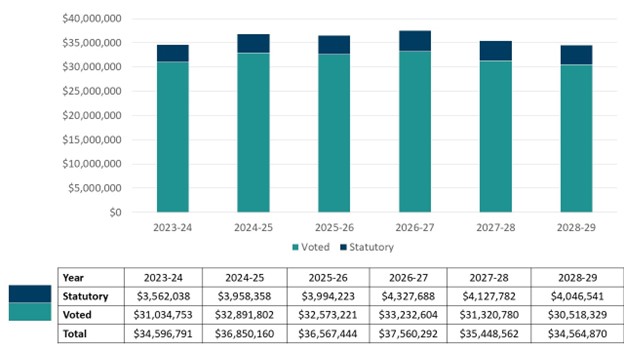
Text version of Graph 1
| Fiscal year | Statutory | Voted | Total |
|---|---|---|---|
| 2023–24 | $3,562,038 | $31,034,753 | $34,596,791 |
| 2024–25 | $3,958,358 | $32,891,802 | $36,850,160 |
| 2025–26 | $3,994,223 | $32,573,221 | $36,567,444 |
| 2026–27 | $4,327,688 | $33,232,604 | $37,560,292 |
| 2027–28 | $4,127,782 | $31,320,780 | $35,448,562 |
| 2028–29 | $4,046,541 | $30,518,329 | $34,564,870 |
Analysis of statutory and voted funding over a six-year period
The above graph illustrates the OPC’s spending trend over a six-year period from 2023–24 to 2028–29. Fiscal years 2023–24 to 2025–26 reflect the organization’s actual expenditures as reported in the Public Accounts. Fiscal years 2026–27 to 2028–29 represent planned spending.
The increased actual spending in 2025–26 and planned spending in 2026–27 are mainly attributable to salary increases, and to the temporary funding received in Budget 2023, namely the funding for activities required to prepare for the implementation of the Consumer Privacy Protection Act that was proposed as part of Bill C-27, and the funding received to reduce the backlog of privacy complaints and address privacy breaches. The OPC anticipates a decrease in its planned spending in future years when this temporary funding comes to an end.
Consult the Public Accounts of Canada for further information on the OPC’s departmental voted and statutory expenditures.
Financial statement highlights
This section presents the OPC’s financial statements (audited) for the year ended March 31, 2026.
Table 9 summarizes the expenses and revenues for 2025–26, which net to the cost of operations before government funding and transfers.
| Financial information | 2025–26 actual results | 2025–26 planned results | Difference (actual results minus planned) |
|---|---|---|---|
| Total expenses | 41,551,000 | 43,752,000 | (2,201,000) |
| Total revenues | 156,000 | 200,000 | (44,000) |
| Net cost of operations before government funding and transfers | 41,395,000 | 43,552,000 | (2,157,000) |
Analysis of expenses and revenues for 2025–26
The variance between the 2025–26 actual results and the 2025-26 planned results is primarily driven by lower-than-expected expenses. This decrease stems from reduced travel expenditures and lower spending on professional services, mainly for information technology services.
The 2025–26 planned results information is provided in the OPC’s Future-Oriented Statement of Operations and Notes 2025–26.
Table 10 summarizes actual expenses and revenues and shows the net cost of operations before government funding and transfers.
| Financial information | 2025–26 actual results | 2024–25 actual results | Difference (2025–26 minus 2024–25) |
|---|---|---|---|
| Total expenses | 41,551,000 | 41,640,000 | (89,000) |
| Total revenues | 156,000 | 190,000 | (34,000) |
| Net cost of operations before government funding and transfers | 41,395,000 | 41,450,000 | (55,000) |
Analysis of differences in expenses and revenues between 2024–25 and 2025–26
In 2025–26, total actual operating expenditures decreased slightly by $89,000 (from $41.64 million to $41.551 million). This net decrease was primarily driven by a $648,000 reduction in non-personnel operating costs, which was largely related to a decrease in professional services. This reduction absorbed a $540,000 increase in salaries and employee benefits.
Table 11 provides a brief snapshot of the amounts the OPC owes or must spend (liabilities) and its available resources (assets), which helps to indicate its ability to carry out programs and services.
| Financial information | Actual fiscal year (2025–26) | Previous fiscal year (2024–25) | Difference (2025–26 minus 2024–25) |
|---|---|---|---|
| Total net liabilities | 5,426,000 | 5,634,000 | (208,000) |
| Total net financial assets | 3,220,000 | 3,652,000 | (432,000) |
| Departmental net debt | 2,206,000 | 1,982,000 | 224,000 |
| Total non-financial assets | 1,437,000 | 1,728,000 | (291,000) |
| Departmental net financial position | (769,000) | (254,000) | (515,000) |
Analysis of OPC’s liabilities and assets since last fiscal year
The net financial position decreased by $0.5 million compared to 2024–25 due to decreases across net liabilities, net financial assets, and non-financial assets. This variance is primarily driven by a significant reduction in year-end payables, a decrease in the amount due from the Consolidated Revenue Fund (CRF), and fewer tangible capital asset acquisitions.
Human resources
This section presents an overview of the OPC’s actual and planned human resources from 2023–24 to 2028–29.
Table 12 shows a summary, in full-time equivalents, of human resources for the OPC’s core responsibilities and for its internal services for the previous three fiscal years.
| Core responsibilities and internal services | 2023–24 actual full-time equivalents | 2024–25 actual full-time equivalents | 2025–26 actual full-time equivalents |
|---|---|---|---|
| Protection of privacy rights | 147 | 171 | 169 |
| Subtotal | 147 | 171 | 169 |
| Internal services | 56 | 58 | 56 |
| Total | 203 | 229 | 225 |
Analysis of human resources for the last three years
The decrease in 2025–26 actual FTEs can be attributed to the anticipated sunsetting funding received as part of Budget 2023 to reduce the backlog of privacy complaints and to undertake more in-depth investigations of privacy breaches.
Table 13 shows the planned full-time equivalents for each of the OPC’s core responsibilities and for its internal services for the next three years. Human resources for the current fiscal year are forecast based on year to date.
| Core responsibilities and internal services | 2026–27 planned full-time equivalents | 2027–28 planned full-time equivalents | 2028–29 planned full-time equivalents |
|---|---|---|---|
| Protection of privacy rights | 172 | 163 | 159 |
| Subtotal | 172 | 163 | 159 |
| Internal services | 59 | 57 | 56 |
| Total | 231 | 220 | 215 |
Analysis of human resources for the next three years
The increase in 2026–27 planned FTEs is due to the temporary funding received as part of Budget 2023, namely the funding for preparation activities required to implement the Consumer Privacy Protection Act that was proposed as part of Bill C-27. The reduction in planned FTEs for the 2026–27 fiscal year and beyond, compared to the past few years, is primarily due to the scheduled changes to the established funding profile related to the Consumer Privacy Protection Act sunsetting funding. The OPC will continue to achieve results by allocating its human resources to best support its priorities and programs.
Supplementary information tables
The following supplementary information tables are available on the OPC’s website:
Federal tax expenditures
The tax system can be used to achieve public policy objectives through the application of special measures such as low tax rates, exemptions, deductions, deferrals and credits. The Department of Finance Canada publishes cost estimates and projections for these measures each year in the Report on Federal Tax Expenditures. This report also provides detailed background information on tax expenditures, including descriptions, objectives, historical information, and references to related federal spending programs, as well as evaluations and GBA Plus analysis of tax expenditures.
Corporate information
Departmental profile
Appropriate ministerFootnote 4: The Honourable Sean Fraser, P.C., K.C., M.P.
Institutional head: Philippe Dufresne
Ministerial portfolioFootnote 5: Department of Justice Canada
Enabling instrument(s): Privacy Act, R.S.C. 1985, c. P-21; Personal Information Protection and Electronic Documents Act, S.C. 2000, c. 5
Year of incorporation or commencement: 1982
Departmental contact information
Mailing address:
Office of the Privacy Commissioner of Canada
30 Victoria Street, 1st Floor
Gatineau, Quebec K1A 1H3
Canada
Telephone: 819-994-5444
Toll-free: 1-800-282-1376
TTYFootnote 6: 819-994-6591
Website: www.priv.gc.ca
Definitions
List of terms
- appropriation (crédit)
- Any authority of Parliament to pay money out of the Consolidated Revenue Fund.
- budgetary expenditures (dépenses budgétaires)
- Operating and capital expenditures; transfer payments to other levels of government, departments or individuals; and payments to Crown corporations.
- core responsibility (responsabilité essentielle)
- An enduring function or role of a department. The departmental results listed for a core responsibility reflect the outcomes that the department seeks to influence or achieve.
- Departmental Plan (plan ministériel)
- A report that outlines the anticipated activities and expected performance of an appropriated department over a three-year period. Departmental Plans are usually tabled in Parliament in spring.
- departmental priority (priorité)
- A plan, project or activity that a department focuses and reports on during a specific planning period. Priorities represent the most important things to be done or those to be addressed first to help achieve the desired departmental results.
- departmental result (résultat ministériel)
- A high-level outcome related to the core responsibilities of a department.
- departmental result indicator (indicateur de résultat ministériel)
- A quantitative or qualitative measure that assesses progress toward a departmental result.
- departmental results framework (cadre ministériel des résultats)
- A framework that connects the department’s core responsibilities to its departmental results and departmental result indicators.
- Departmental Results Report (rapport sur les résultats ministériels)
- A report outlining a department’s accomplishments against the plans, priorities and expected results set out in the corresponding Departmental Plan.
- Full-time equivalent (équivalent temps plein)
- Measures the person-years in a departmental budget. A full-time equivalent is calculated by an employee’s scheduled hours per week divided by the employer’s hours for a full-time workweek. For example, an employee who works 20 hours in a 40-hour standard workweek represents a 0.5 full-time equivalent.
- Gender-based Analysis Plus (GBA Plus) (Analyse comparative entre les sexes Plus [ACS Plus])
- An analytical tool that helps to understand the ways diverse individuals experience policies, programs and other initiatives. Applying GBA Plus to policies, programs and other initiatives helps to identify the different needs of the people affected, the ways to be more responsive and inclusive, and the methods to anticipate and mitigate potential barriers to accessing or benefitting from the initiative. GBA Plus goes beyond biological (sex) and socio-cultural (gender) differences to consider other factors, such as age, disability, education, ethnicity, economic status, geography (including rurality), language, race, religion, and sexual orientation.
- government priorities (priorités pangouvernementales)
- For the purpose of the 2025–26 Departmental Results Report, government priorities are the high-level themes outlining the government’s agenda as announced in the 2025 Speech from the Throne.
- horizontal initiative (initiative horizontale)
- A program, project or other initiative where two or more federal departments receive funding to work collaboratively on a shared outcome usually linked to a government priority, and where the ministers involved agree to designate it as horizontal. Specific reporting requirements apply, including that the lead department must report on combined expenditures and results.
- Indigenous business (enterprise autochtones)
- Requirements for verifying Indigenous businesses for the purposes of the Departmental Results Report are available through Indigenous Services Canada’s Mandatory minimum 5% Indigenous procurement target web page.
- non‑budgetary expenditures (dépenses non budgétaires)
- Net outlays and receipts related to loans, investments and advances, which change the composition of the financial assets of the Government of Canada.
- performance (rendement)
- What a department did with its resources to achieve its results, how well those results compare to what the department intended to achieve, and how well lessons learned have been identified.
- performance indicator (indicateur de rendement)
- A qualitative or quantitative measure that assesses progress toward a departmental-level or program-level result, or the expected outputs or outcomes of a program, policy or initiative.
- plan (plan)
- The articulation of strategic choices, which provides information on how a department intends to achieve its priorities and associated results. Generally, a plan will explain the logic behind the strategies chosen and tend to focus on actions that lead to the expected result.
- planned spending (dépenses prévues)
- For Departmental Plans and Departmental Results Reports, planned spending refers to the amounts presented in the Main Estimates. Departments must determine their planned spending and be able to defend the financial figures presented in their Departmental Plans and Departmental Results Reports.
- program (programme)
- An Individual, group, or combination of services and activities managed together within a department and focused on a specific set of outputs, outcomes or service levels.
- program inventory (répertoire des programmes)
- A listing that identifies all the department’s programs and the resources that contribute to delivering on the department’s core responsibilities and achieving its results.
- result (résultat)
- An outcome or output related to the activities of a department, policy, program or initiative.
- statutory expenditures (dépenses législatives)
- Spending approved through legislation passed in Parliament, other than appropriation acts. The legislation sets out the purpose and the terms and conditions of the expenditures.
- target (cible)
- A quantitative or qualitative, measurable goal that a department, program or initiative plans to achieve within a specified time period.
- voted expenditures (dépenses votées)
- Spending approved annually through an appropriation act passed in Parliament. The vote also outlines the conditions that govern the spending.
- Date modified: